
More Information
Submitted: March 24, 2026 | Accepted: April 03, 2026 | Published: April 04, 2026
Citation: Fang-an D, Xin Z, Liang Z, Lanlan Y, Qiaoxia L. On FBZ-Algebras. J Artif Intell Res Innov. 2026; 2(1): 021-035. Available from:
https://dx.doi.org/10.29328/journal.jairi.1001015
DOI: 10.29328/journal.jairi.1001015
Copyright license: © 2026 Fang-an D, et al. This is an open access article distributed under the Creative Commons Attribution License, which permits unrestricted use, distribution, and reproduction in any medium, provided the original work is properly cited.
Keywords: FBZ-algebra; s-FBZ-algebra; L-algebra; Quotient FBZ-algebras; MSC(2020): 06F35, 03G25, 08A30

On FBZ-Algebras
Deng Fang-an, Zhou Xin, Zhang Liang, Yi Lanlan and Li Qiaoxia*
School of Mathematics and Statistics, YiLi Normal University, 835000 YiLi, China
*Corresponding author: Li Qiaoxia, School of Mathematics and Statistics, YiLi Normal University, 835000 YiLi, China, Email: [email protected]
This paper introduces the concept of FBZ-algebra as a generalization of fuzzy implication algebra and investigates its fundamental properties. We establish a sufficient condition for an FBZ-algebra to become a fuzzy implication algebra. Furthermore, we examine s-FBZ-algebras, filters, and upper sets, and explore the relationships between FBZ-algebras and other logical algebras, including GE-algebras, BE-algebras, KU-algebras, UP-algebras, GK-algebras, L-algebras, and BCK-algebras. Finally, the structure of quotient FBZ-algebras is constructed and analyzed.
In the study of logical systems, people use algebraic theories as tools to abstract different logical systems into algebraic models with certain structures. In 1958, C.C. Chang combined implication operators with other connectives into MV-algebras and proved that the completeness theorem for finite-valued Lukasiewicz logic systems with a finite base set (domain) holds true. Heyting algebras were introduced as an algebraic model for intuitionistic propositional logic and are considered a generalization of Boolean algebras [1]. To study fuzzy reasoning, in 1990, Wu Wangming introduced the model of fuzzy implication algebras (FI-algebras), which is an algebraic abstraction of implication operators in logical systems with values in the interval [0,1]. In 1993, Xu Yang, from a semantic perspective, restricted the values of propositions in logical systems to the structure of lattices, establishing lattice implication algebras and achieving significant results in a series of lattice-valued logical systems. He also proposed some views on fuzzy logic from the perspective of machine intelligence, laying an algebraic foundation for uncertain reasoning and automated reasoning in handling uncertain information [2,3].
In recent years, scholars have further considered some subalgebras of FI-algebras, proposing concepts such as ideals and filters of FI-algebras. Research findings on the relationships between FI-algebras and other logical algebraic systems, such as BCK-algebras, MV-algebras, Heyting algebras, etc., have also received widespread attention in academic circles [4,5]. In 2019, Andrzej Walendziak studied generalized BCK-algebras (including RM, RML, BCH, BCC, BZ, BCI algebras, etc.) and explored the commutativity of these algebraic systems [6]. BE-algebras are the generalization of BCK-algebras and have close relationships with other algebraic structures. For example, BE-algebras have certain connections with Hilbert algebras, MV-algebras, quantum B-algebras, equational algebras, and EQ-algebras, etc. Later, KU-algebras, UP-algebras, and GK-algebras were introduced as algebraic logical systems. A KU-algebra can be regarded as a special kind of algebraic structure used to describe a specific logical relationship, scholars have introduced the concept of fuzzy KU-ideals and studied fuzzy logic and related issues. A. Iampan introduced UP-algebras as a new kind of algebraic, which is considered to be a generalization of KU-algebras. UP-algebras not only extend the scope of the study of KU-algebras but also introduce new concepts such as UP-ideals, UP-subalgebras, etc., which are of theoretical value in logical algebras. These research works further enriched the research results of non-classical logic. In recent years, non-classical logical algebras such as FBZ-algebras have demonstrated significant potential in the field of artificial intelligence. The structural properties of their implication operations are particularly suitable for representing uncertain reasoning rules [7], providing an algebraic foundation for fuzzy logic systems, automated reasoning engines, and knowledge representation models. For instance, in fuzzy neural networks [8], the implication operation of FBZ-algebras can be employed to construct interpretable reasoning layers, while in intelligent decision-making systems, their partial order relations can model preference reasoning.
The concept of the FBZ-algebra system was introduced by the author in 1999, and the basic properties of the FBZ-algebra were given [9]. In 1996, in the process of studying FI-algebras, we found class of subalgebras of FI-algebras with good properties, called Wd-FI-implication algebras, and proved that this kind of subalgebras is a special regular but not FI-algebra [10]. In [11], the properties of FBZ-algebras, and their relations among with algebraic systems such as FI-algebras, and Wd-FI-algebras.
The paper is organized as follows. In Section 2, we present various notions and results used in the paper. In Section 3, Elementary properties of FBZ-algebras are given. In Section 4, we consider the direct product of FBZ-algebras. In Section 5, we discuss relations among FBZ-algebras, BE-algebras, KUalgebras, UP-algebras, GK-algebras and GE-algebras. In the final section, the FBZ-filter and the Quotient FBZ-algebras are established.
We recall some basic definitions and results that are necessary for this paper.
Definition 2.1. [9,10] An FBZ-algebra is a triplet (X;→, 1) where X is a nonempty set, → is a binary operation and 1 is a nullary operation on X and the following axioms hold for each x, y, z ∈ X:
(F1)(x → y) → ((y → z) → (x → z)) = 1,
(F2)1 → x = x,
(F3) if x → y = 1 and y → x = 1, then x = y.
Example 2.1. Let X = {1, a, b, c, d} in which the operation → is given by the Table 1:
| → | 1 | a | b | c | d |
| 1 | 1 | a | b | c | d |
| a | 1 | 1 | b | 1 | d |
| b | 1 | a | 1 | c | d |
| c | 1 | 1 | b | 1 | d |
| d | 1 | a | 1 | c | 1 |
It is easy to see that (X; →, 1) is an FBZ-Algebra.
An FBZ-algebra (X; →, 1) is said to be left self-distributive if
x → (y → z) = (x → y) → (x → z) (2.1)
for all x, y, z ∈ X.
A non-empty subset S of an FBZ-algebra X is said to be a subalgebra of X if x → y ∈ S whenever x, y ∈ S.
In an FBZ-algebra, the following identity is true:
(F4)x → x = 1.
By (F1), Put x = y = 1 in (F1), we get (1 → 1) → ((1 → x) → (1 → x)) = x → x = 1. It follows that x → x = 1. Thus, we have axiom (F4) holds.⿒
Definition 3.1. An FBZ-algebra (X; →, 1) is said to be strong(Abbreviated as s-FBZ-algebra), if it satisfies:
(x → y) → z = (z → y) → x (3.1)
for all x,y,z ∈ X.
Theorem 3.1. Every s-FBZ-algebra is an FBZ-algebra.
Proof. Straightforward.
The converse of Theorem 3.1 is not true in general as seen in the following example.
Example 3.1. Let X = {1, a, b} in which → is defined by Table 2:
| → | 1 | a | b |
| 1 | 1 | a | b |
| a | 1 | 1 | b |
| b | 1 | a | 1 |
Then, (X;∗, 1) is an FBZ-algebra. But (a → a) → b = 1 → b = b =6 (b → a) → a = a → a = 1. So, condition (3.1) does not hold.
Hence, s-FBZ-algebras is a subclass of FBZ-algebras.
Theorem 3.2. Let (X, → 1) be an s-FBZ-algebra. Then the following hold:
1) x → (y → z) = y → (x → z) (left exchangeable),
2) x → y = 1 and y → z = 1 imply x → z = 1( transitive),
3) x → y = 1 imply (z → x) → (z → y) = 1, and (y → z) → (x → z) = 1,
4) (x → y) → y = x,
5) x → 1 = x imply x → y = y → x,
6) ((x → y) → y) → ((x → y) → z) = y → z,
7) ((x → y) → y) → y = x → y,
8) ((x → y) → y) → x) → ((x → y) → y) → z) = x → z.
Proof. By (F1), 1 = (x → y) → ((y → z) → (x → z)) = (((y → z) → (x → z)) → y) → x = ((y →
→ z)) → (y → z)) → x = (x → (y → z)) → (y → (x → z)).
Similarly, 1 = (y → x) → ((x → z) → (y → z)) = (((x → z) → (y → z)) → x) → y = ((x → (y →
z)) → (x → z)) → y = (y → (x → z)) → (x → (y → z)).
So, (x → (y → z)) → (y → (x → z)) = 1 = (y → (x → z)) → (x → (y → z)).
By (F3), we obtain
x → (y → z) = y → (x → z).
Thus, (1) holds.
Next, we give another proof method for (1).
Since, (x → (y → z)) → (y → (x → z)) = ((y → (x → z) → (y → z)) → x = (((y → z) → (x → z)) → y) → x = (((x → z) → z) → y) → y) → x = (((z → z) → x) → y) → y) → x = (((1 → x) → y) → y) → x = ((x → y) → y) → x = ((y → y) → x) → x = (1 → x) → x = x → x = 1.
Similarly, we have (y → (x → z)) → (x → (y → z)) = 1. By (F3), we get x → (y → z) = y → (x → z).
(2) x → z = x → (1 → z) = x → ((y → z) → z) = x → ((z → z) → y) = x → (1 → y) = x → y = 1.
So, (2) holds.
(3) By x → y = 1, we get
(z → x) → (z → y) = ((z → y) → x) → z = ((x → y) → z) → z = (1 → z) → z = z → z = 1. and
→ z) → (x → z) = ((x → z) → z) → y = ((z → z) → x) → y = (1 → x) → y = x → y = 1.
(4) (x → y) → y = (y → y) → x = 1 → x = x.
(5) Since x → y = (x → 1) → y = (y → 1) → x = y → x. So, if x → 1 = x, then x → y = y → x.
(6) ((x → y) → y) → ((x → y) → z) = ((y → y) → x) → ((x → y) → z) = (1 → x) → ((z → y) →
x) = x → ((z → y) → x) = (z → y) → (x → x) = (z → y) → 1 = (1 → y) → z = y → z.
(7) ((x → y) → y) → y = (y → y) → (x → y = 1 → (x → y) = x → y.
(8) ((x → y) → y) → x) → ((x → y) → y) → z) = ((x → y) → (x → y)) → (((y → y) → x) → z) = (1 → x) → z = x → z.
Definition 3.2. An FBZ-algebra (X,→, 1) is said to be commutative if a → b = b → a for all a, b ∈ X. If X is not commutative, then it is called a noncommutative FBZ-algebra.
By Theorem 3.2: Any s-FBZ-algebra be commutative, if x → 1 = x.
In a FBZ-algebra (X;→, 1), a binary relation “≤” is defined by
(∀u,v ∈ X)(u ≤ v ⇔ u → v = 1.) (3.2)
From (F3) and (F4), we have the order relation ≤ determined by (3.2) is a compatible relation.
It is known from (2), we have: if (X;→, 1) is a strong FBZ-algebras, i.e, condition (3.1) is satisfied, then the order relation ≤ determined by (3.2) is a Partial order relation.
Theorem 3.3. Let (X;→, 1) be a nonempty set with a binary operation → satisfying the following axioms: for all x,y,z ∈ X,
(F2)1 → x = x,
(F4)x → x = 1,
(F5)(x → y) → z = (z → y) → x.
Then (X,→, 1) is an FBZ-algebra, and it is also a strong FBZ-algebra.
Proof. By (F4) and (F5), we get
(x → y) → ((y → z) → (x → z)) = (x → y) → (((x → z) → z) → y) = (x → y) → (((z → z) → x) →
y) = (x → y) → ((1 → x) → y) = (x → y) → (x → y) = 1. Thus, (F1) holds.
By (F4) and (F5), we get x = 1 → x = (y → x) → x = (x → x) → y = 1 → y = y impies x = y, So, (F3) holds. Condition (F2) is given by the hypothesis. Thus, (X,→, 1) is a FBZ-algebra, and it is also a strong FBZ-algebra.
We discuss the interrelation between FBZ-algebras and other algebraic systems of BE-algebras, KUalgebras, UP-algebras, GK-algebras, GE-algebras, etc.
4.1 Relation with BE-algebras
In 2007, H. S. Kim, Y. H. Kim introduced the notion of a BE-algebra as a generalization of a dual BCK-algebra. BE-algebras have close relationships with other algebraic structures [11]. The application of BE-algebras in logical systems is not limited to theoretical research, but also involves solving practical problems. By comparing and linking with other algebraic structures, BE-algebras further expand their application scope, making them play an important role in many such as logic, computer science, and so on [12].
Next, we introduce the concept of BE-algebra.
Definition 4.1. [11,13] An algebra (X;∗, 1) of type (2, 0) is called a BE-algebra if
(BE1) x ∗ x = 1 for all x ∈ X;
(BE2) x ∗ 1 = 1 for all x ∈ X;
(BE3) 1 ∗ x = x for all x ∈ X;
(BE4) x ∗ (y ∗ z) = y ∗ (x ∗ z) for all x,y,z ∈ X ( exchange ).
Example 4.1. [13] Let X := {1,a,b,c,d} be a set with a binary operation ∗ defined by the following Table 3:
| ∗ | 1 | a | b | c | d |
| 1 | 1 | a | b | c | d |
| a | 1 | 1 | b | c | d |
| b | 1 | a | 1 | c | c |
| c | 1 | 1 | b | 1 | b |
| d | 1 | 1 | 1 | 1 | 1 |
It is easy to see that (X;∗, 1) is a BE-algebra.
Proposition 4.1. Let (X,∗, 1) be a s-FBZ-algebra, if for all x ∈ X such that x → 1 = 1, then (X,→, 1) is a BE-algebra.
Proof. It is immediate to cheek that (X,→, 1) is a BE-algebra.
The converse of Proposition 4.1 does not hold. To see this, consider the BE-algebra (X;∗, 1) in Example 4.1, (a ∗ b) ∗ c = b ∗ c = c, and (c ∗ b) ∗ a = b ∗ a = a, this way a =6 c, so, from Theorem 3.3 (F5) is not satisfied. Thus, (X;∗, 1) is not an s- FBZ-algebra.
4.2 Relation with KU-algebras
2009, C. Prabpayak and U. Leerawat studied ideals and congruences of BCC–algebras and introduced a new algebraic structure which is called KU-algebra. They gave the concept of homomorphisms of KUalgebras and investigated some related properties [14].
Definition 4.2. [14] An algebra (A;·,1) of type (2,0) is called a KU-algebra, where A is a nonempty set, · is a binary operation on A, and 1 is a fixed element of A (i.e., a nullary operation) if it satisfies the following axioms: for any x, y, z ∈ A,
(KU1)(x · y) · ((y · z) · (x · z)) = 1,
(KU2)1 · x = x,
(KU3)x · 1 = 1,
(KU4)x · y = y · x = 1 implies x = y.
Example 4.2. [14] Let X = {1,a,b,c} be a set with a binary operation ∗ defined by the following Cayley Table 4:
| ∗ | 1 | a | b | c |
| 1 | 1 | a | b | c |
| a | 1 | 1 | b | c |
| b | 1 | a | 1 | c |
| c | 1 | 1 | 1 | 1 |
Then, (X;∗, 1) is a KU-algebra.
Proposition 4.2. Any KU-algebras must be an FBZ-algebra, Conversely, an FBZ-algebra (X,∗,1) satisfies: for all x ∈ X, x → 1 = 1, then (X,→,1) is a KU-algebra.
Proof. It follows from Definition 2.1 and Definition 4.2.
4.3 Relation with UP-algebras
2017, A.IAMPAN introduce a new algebraic structure, called a UP-algebra (UP means the University of Phayao)and a concept of UP-ideals, UP-subalgebras, congruences and UP-homomorphisms in UPalgebras, and investigated some related properties of them [15]. A. IAMPAN also describe connections between UP-ideals, UP-subalgebras, congruences and UP-homomorphisms, and show that the notion of UP-algebras is a generalization of KU-algebras.
Definition 4.3. [15,16] A UP-algebra is an algebra (X;?,1) of type (2,0) satisfying the following axioms: for all x,y,z ∈ X,
(UP1)(y ? z) ? [(x ? y) ? (x ? z)] = 1,
(UP2)1 ? x = x,
(UP3)x ? 1 = 1,
(UP4)x ? y = y ? x = 1 implies x = y.
Example 4.3. [15] Let X = {1, a, b, c} be a set with a binary operation? defined by the following Cayley Table 5:
| ? | 1 | a | b | c |
| 1 | 1 | a | b | c |
| a | 1 | 1 | b | b |
| b | 1 | a | 1 | b |
| c | 1 | a | 1 | 1 |
Then, (X;?,1) is a UP-algebra.
Proposition 4.3. [15] Any KU-algebra is a UP-algebra.
In view of Proposition 4.3, the notion of UP-algebras is a generalization of KU-algebras.
Proposition 4.4. Any UP-algebras is an FBZ-algebra. Conversely, an s-FBZ-algebra (X,→, 1) satisfies: for all x ∈ X, x → 1 = 1, then (X,→, 1) is a UP-algebra.
Proof. It follows from Definition 2.1 and Definition 4.3, we obtain UP-algebra is subclass of FBZalgebras. Conversely, a s-FBZ-algebra (X,→, 1) satisfies: for all x ∈ X,x → 1 = 1, by (1) in Theorem 3.2, we get
1 = (x → y) → ((y → z) → (x → z)) = (y → z) → (((x → y) → (x → z).
So, (UP1) holds. According to the hypothesis (UP2)−(UP4) obviously true. This completes the proof.
4.4 Relation with GK-algebras
2018, R. Gowri, J. Kavitha introduced the notion of GK-algebra and studied about some of their properties [16]. R. Gowri, J. Kavitha show that a GK-algebra need not be a BE algebra, and need not be a CI algebra. A GK-algebra is a CI algebra and BE-algebra satisfies the additional relations are investigated [17].
Definition 4.4. [17] A non-empty set X with fixed constant 1 and a binary operation ∗ is called GK-algebra if it satisfying the following axioms:
I. x ∗ x = 1,
II. x ∗ 1 = x,
III. x ∗ y = 1 and y ∗ x = 1 implies x = y,
IV. (y ∗ z) ∗ (x ∗ z) = y ∗ x,
V. (x ∗ y) ∗ (1 ∗ y) = x for all x,y,z ∈ X.
Example 4.4. [16] Consider the set X = {1, 2, 3} with binary operation ∗ is defined as follows Table 6:
| ∗ | 1 | 2 | 3 |
| 1 | 1 | 3 | 2 |
| 2 | 2 | 1 | 3 |
| 3 | 3 | 2 | 1 |
en, (X,∗, 1) is a GK-algebra.
Proposition 4.5. Any s-FBZ-algebra (X,∗, 1) satisfies: for all x ∈ X, x → 1 = x, then (X,→, 1) is a GK-algebra.
Proof. By Suppose conditions, we have (i), (ii) and (iii) are satisfied.
By (F5), (y ∗ z) ∗ (x ∗ z) = ((x ∗ z) ∗ z) ∗ y = ((z ∗ z) ∗ x) ∗ y = (1 ∗ x) ∗ y = (y ∗ x) ∗ 1 = y ∗ x. So, (iv) holds.
(V)(x ∗ y) ∗ (1 ∗ y) = (x ∗ y) ∗ y = (y ∗ y) ∗ x = 1 ∗ x = x.
Hence,(V) holds. Therefore, (X,∗, 1) is a GK-algebra.
The next result gives a relations for FBZ-algebras (or s-FBZ-algebras) between BE-algebras, UPalgebras, KU-algebras and GK-algebras.
4.5 Relation with BCI-algebras and Fuzzy implication algebras
In this section, we give conditions under which an FBZ-algebra to become a BCI-algebras and an implication algebra.
Definition 4.5. [18] A BCI-algebra is an algebra (X;◦, 1) of type (2,0) satisfying the following axioms:
for all x, y, z ∈ X,
(BCI-1) ((x ◦ y) ◦ (x ◦ z)) ◦ (z ◦ y) = 1,
(BCI-2) ((x ◦ (x ◦ y)) ◦ y = 1,
(BCI-3) x ◦ x = 1,
(BCI-4) x ◦ y = y ◦ x = 1 ⇒ x = y.
Proposition 4.6. [10] If (X;→, 1) be an FBZ-algebra, and it is satisfy axiom: for all x, y, z ∈ X,
x → (y → z) = y → (x → z),
then the algebra (X;◦, 1) induced by x◦y = y → x is a BCI-algebra. Conversely, an FBZ-algebra (X;→, 1) is a BCI-algebra induced by x → y = y ◦ x.
Definition 4.6. [19] A Fuzzy implication algebra is an algebra (X;,→, 1) of type (2,0) satisfying the following axioms: for all x, y, z ∈ X,
(I-1) (x ,→ y) ,→ ((y ,→ z)) ,→ (x ,→ z)) = 1,
(I-2) (x ,→ (y ,→ z) = y ,→ (x ,→ z),
(I-3) x ,→ x = 1,
(I-4) x ,→ y = y ,→ x = 1 ⇒ x = y, (I-5) 1 ,→ x = 1.
Proposition 4.7. [10] Any a Fuzzy implication algebra is an FBZ-algebra. Conversely, Let (X;→, 1) be an FBZ-algebra, and it is meet one of the following two conditions: for all x, y, z ∈ X,
x → (y → z) = y → (x → z),
or
(x → y) → z = (z → y) → x.
then (X;→, 1) is a Fuzzy implication algebra.
Definition 4.7. [9] An algebraic system (X;→, 0) of type (2,0) is called an Wd-fuzzy implicative algebra, denoted by Wd-FI-algebra, if it satisfies the following axioms: for any x, y, z ∈ X,
(W1)x → (y → z) = y → (x → z),
(W2)(x → y) → z = (z → y) → x),
(W3)x → x = 1,
(W4) if x → y = y → x = 1,
(W5)0 → x = 1, where 1 = 0 → 0.
Proposition 4.8. [10] Every Wd-FI-algebra is an FBZ-algebra. Not true conversely.
4.6 Relation with GE-algebras
In this section, we give conditions under which an FBZ-algebra to become a GE-algebra.
Definition 4.8. [20] A GE-algebra is a non-empty set X with a constant 1 and a binary operation satisfying axioms:
(GE1)x ∗ x = 1, (GE2)1 ∗ x = x,
(GE3)x ∗ (y ∗ z) = x ∗ (y ∗ (x ∗ z)), for all x, y, z ∈ X.
Proposition 4.9. Every self-distributive FBZ-algebra is a GE-algebra.
Proof. Let (X;→, 1) be a left self-distributive FBZ-algebra and x, y, z ∈ X.
Then x → (x → y) = (x → x) → (x → y) = 1 → (x → y) = x → y, and x → (y → (x → z)) = (x → y) → (x → (x → z)) = (x → y) → (x → z) = x → (y → z).
Hence (X;→, 1) is a GE-algebra.
The converse of the above theorem need not be true.
Example 4.5. Let X = {1, a, b, c, d} be a set with a binary operation? the following Table 7.
| ? | 1 | a | b | c | d |
| 1 | 1 | a | b | c | d |
| a | 1 | 1 | b | b | 1 |
| b | 1 | a | 1 | 1 | d |
| c | 1 | a | 1 | 1 | d |
| d | 1 | 1 | c | c | 1 |
n, (X;∗, 1) is a GE-algebra. But not FBZ-algebra, since c ∗ b = 1 = b ∗ c, b = 6 c, So, (F3) is not satisfied. Hence, (X;∗, 1) is not an FBZ-algebra.
4.7 Relation with L-algebras
In 2008, Rump introduced L-algebras, which are related to algebraic logic and quantum structures [21]. Many examples shown that L-algebras are very useful.2012, Rump and Yang characterized pseudo-MValgebras and Bosbach’s non-commutative bricks as L-algebras [22]. 2023, M. Aaly Kologani investigate different types of L-algebras and provide finite and infinite examples of them [23], the relations among hoops and some logical algebras such as MT L-algebras, BL-algebras, MV -algebras, BCK-algebras and Hilbert algebras are investigated [24]. This section we do a small statement about a link between FBZalgebras and L-algebras.
Definition 4.9. [21] An algebraic structure (L;→, 1) is called an L-algebra if for any x, y, z ∈ L satisfies in the following conditions:
(L1)x → x = x → 1 = 1 and 1 → x = x,
(L2)(x → y) → (x → z) = (y → x) → (y → z),
(L3) if x → y = y → x = 1, then x = y.
Proposition 4.10. Every s-FBZ-algebra with x → 1 = 1 is an L-algebra.
Proof. By Definition 2.1 and the condition (3.1) of s-FBZ-algebra, we need only verify that axiom (L3) holds. In fact, on the one hand,
(x → y) → (x → z) = x → ((x → y) → z)
= x → ((z → y) → x) = (z → y) → (x → x)
= (z → y) → 1 = 1.
On the other hand,
(y → x) → (y → z) = y → ((y → x) → z)
= y → ((z → x) → y) = (z → x) → (y → y)
= (z → x) → 1 = 1.
Hence, (L3) holds. Therefore, every s-FBZ-algebra with x → 1 = 1 is an L-algebra.
Remark 4.11. By the above Proposition 4.10 and Definition 2.6, 2.7 in [24], we have a s- FBZ-algebra with x → 1 = 1 is an KL-algebra and CL-algebra.
4.8 Relation with BCK-algebras
In 1966, Imai and Iseki [25] introduced two classes of abstract algebras, BCK-algebras and BCIalgebras. It is known that the class of BCK-algebras is a proper subclass of the class of BCI-algebras. It is well known that the class of MV -algebras is a proper subclass of the class of BCK-algebras. Therefore, both BCK-algebras and MV -algebras are important for the study offuzzy logic. In this section, we investigate the relation between FBZ-algebras and BCK-algebras.
Definition 4.10. [25] An algebraic structure (A,→, 1) of type (2,0) is called a BCK-algebra if for any x, y, z ∈ A the following conditions hold:
(BCK1)(x → y) → ((y → z) → (x → z)) = 1,
(BCK2)1 → x = x,
(BCK3)x → 1 = 1,
(L3) if x → y = y → x = 1, then x = y.
Proposition 4.12. Every s-FBZ-algebra with x → 1 = 1 is a BCK-algebra.
Proof. By Definition 2.1, Proposition 4.9 and the condition (3.1) of s-FBZ-algebra, we have (BCK2),(BCK3) and (L3) hold. We need only verify that axiom (BCK1) holds. Exploit conditional equations (3.1), we get
(x → y) → ((y → z) → (x → z))
= (x → y) → ((x → z) → z) → y)
= (x → y) → (((z → z) → x) → y)
= (x → y) → ((1 → x) → y) = (x → y) → (x → y) = 1.
So, axiom (BCK1) holds. Hence, Every s-FBZ-algebra with x → 1 = 1 is a BCK-algebra.
The significance of the FBZ-algebra system in the study of non-classical logic lies in its provision of an abstract that can unify and relate various existing algebraic structures of logic. Through its basic definitions (especially its strong form, s-FBZ-algebra) and additional different conditions, the FBZ-algebra can be explicitly linked to the algebras of fuzzy implication, BCK/BCI-algebras, BE-algebras, KU-algebras, UP-algebras, G-algebras, GE-algebras, and L-algebras, etc. This indicates that the FBZ-algebra has a high degree of flexibility and generality, and can serve as a basis or comparative platform for studying the algebraic semantics of these non-classical logics. For instance, an s-FBZ-algebra becomes a BCK-algebra when it satisfies condition x → 1 = 1, and it becomes a GK-algebra when it satisfies the condition x → 1 = x. This property allows the results of the of FBZ-algebras to potentially radiate to a series of concrete logical algebras (Figure 1).,→ᭁ
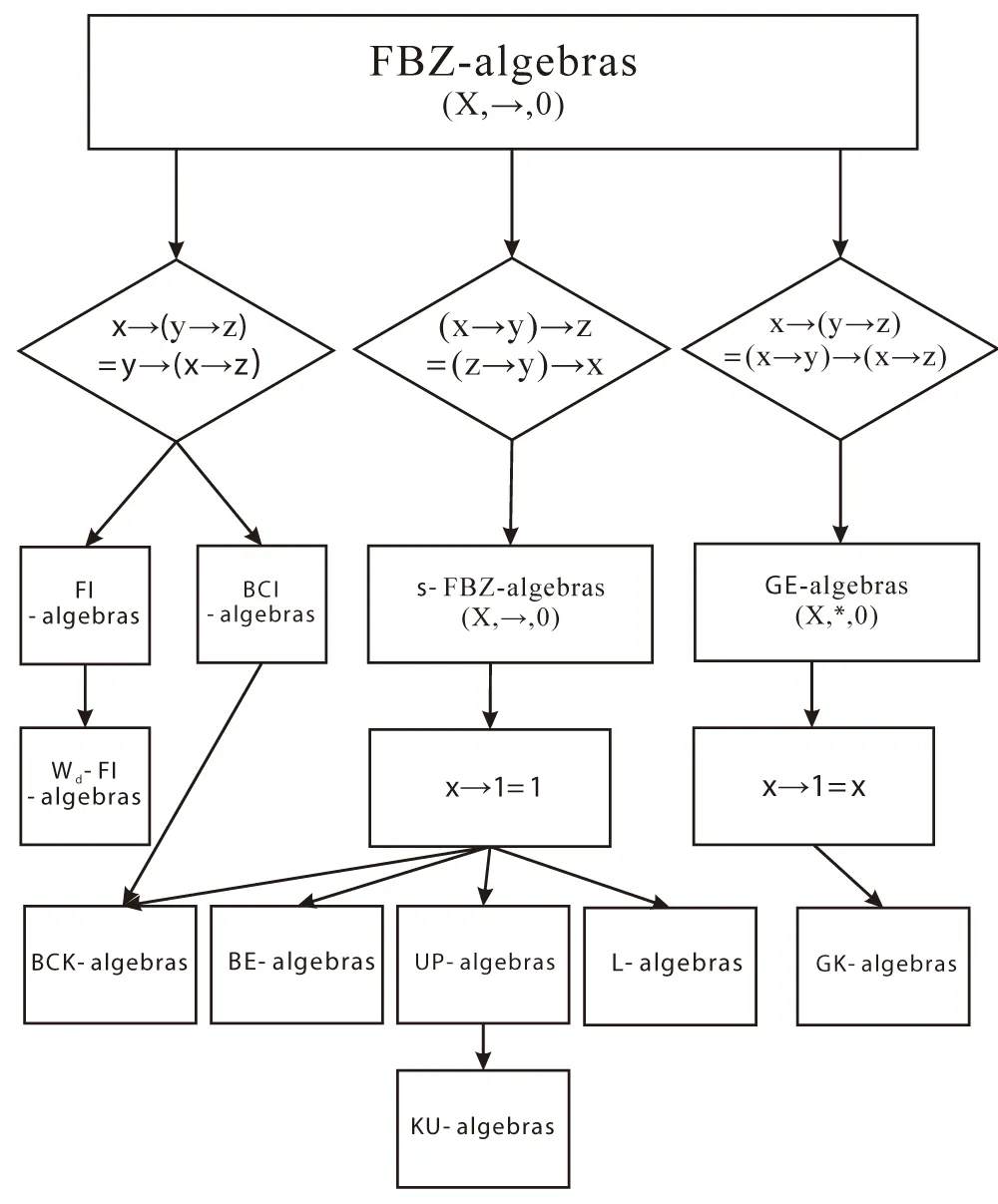
Figure 1: The relationships between FBZ-algebras and other algebras.
5.1 Fuzzy inference systems
The operation → in an FBZ-algebra can model fuzzy “IF-THEN” rules. For example, in a fuzzy controller, the rule “IF error is large AND error-change is large, THEN output is large” can be formalized as:
(a1 → a2) → u.
where a1, a2 are input fuzzy sets and u is the output. The reflexivity x → x = 1 in an FBZ-algebra ensures the completeness of rules, while transitivity supports multi-step reasoning chains.
5.2 Knowledge representation and semantic networks
In knowledge graphs, relationships between entities can be modeled by the partial order relation (≤) in FBZ-algebras. For example, if “birds ≤animals”, then bird → animal = 1. The commutativity property in s-FBZ-algebras (Theorem 3.2) can support bidirectional reasoning, enhancing flexibility in knowledge acquisition.
5.3 Interpretable machine learning
FBZ-filters (Definition 7.3) can be used to extract redundant features from rule sets. For instance, in decision tree models, if a feature x satisfies x → y = 1and x → z = 1, then the quotient algebra X/ ∼ F can merge equivalent rules, thereby reducing model complexity.
5.4 Handling uncertain information
The annihilator in an FBZ-algebra (Definition 7.6) can resolve conflicting information. In multi-agent systems, if decisions of agents a and b satisfy ann(a) = ann(b), their decision equivalence classes can be merged to reduce communication overhead.
Direct product plays an important role in algebraic structures. In 2016, Randy C. Teves introduce the direct product of BF-algebras and obtain some properties of this concept [26]. In 2018, J Kavitha, R. Gowri discuss about direct product of GK-algebra and obtain its some interesting results [17]. In 2019, Widianto S, Gemawati S, Kartini were discussed about the Direct product of BG-algebra [27]. Likewise, many authors have discussed this topic in their work. Motivated by these, in this paper we discuss about the direct product of FBZ-algebra and investigate its properties.
Definition 6.1. Let and be FBZ-algebras. Direct product M × N is defined as a structure M × N = (M × N; ⊗; (1M; 1N)), where M × N is the set {(m,n)|m ∈ M,n ∈ N} and ⊗ is given by
This shows that the direct product of two sets of FBZ-algebra M and N is denoted by M × N, which each (m, n) is an ordered pair.
Proposition 6.1. Direct product of any two FBZ-algebras is again an FBZ-algebra.
Proof. Let M and N be FBZ-algebras, m1, m2 ∈ M and n1,n2 ∈ N. M × N = (M ×N; ⊗; (1M;1N)).
Since 1M ∈ M, 1N ∈ N. This implies that (1M, 1N) ∈ M × N. So, M × N is non-empty.
Now let us prove it is an FBZ-algebra. By definition of FBZ-algebra, we have
(1)
So, (F1) holds.
(2) .
Hence, (F2) holds.
(3) If (m1, n1) ⊗ (m2, n2) = (1M, 1N) and (m2, n2) ⊗ (m1, n1) = (1M, 1N), then
and and n1 = n2.
Hence, (F3) holds.
Proposition 6.2. Letandbe the family of FBZ-algebras and let ζi : Mi → Ni,(i = 1,2,...,n) be the set of isomorphism. If ζ from given by ζ(mi),(i = 1,2,...,n) = ζi(mi),(i = 1,2,...,n), then ζ is also an isomorphism.
Proof. Let and be the family of FBZalgebras and let ζi : Mi → Ni,(i = 1,2,...,n) be the set of isomorphism. ζ from given by ζ(mi),(i = 1,2,...,n) = ζi(mi),(i = 1,2,...,n).
Next, we have to prove ζ is an isomorphism.
, then
This show that ζ is a homomorphism.
We have to prove ζ is onto, we have ζi is onto, where i = 1,2,...,n.
Let (n1,n2,......nn) ∈ N1 × N2 × ... × Nn, since ζ is onto, ni ∈ Ni, there exists mi ∈ Mi such that ζi(mi) = ni, for i = 1,2,...,n. we have:
(n1,n2,...,nn) = (ζ1(m1), ζ2(m2),...,ζn(mn)) = ζ(m1, m2,.....mn).
So, ζ is onto.
Now, to prove ζ is one-to-one mapping.
By ζ(m1,m2,...,mn) = ζ(n1,n2,...,nn)
⇒ ((ζ1(m1),ζ2(m2),...,ζn(mn)) = ((ζ1(n1),ζ2(n2),...,ζn(nn))
⇒ ζi(mi) = ζi(ni)
⇒ mi = ni , where i = 1,2,...,n.
Because ζi is one-to-one mapping, we get
(m1,m2,.....mn) = (n1,n2,...,nn)
So, ζ is one-to-one mapping. Hence ζ is an isomorphism.
In a BE-algebra, filters are important substructures and play an important role. Also, as it is well known that filters are exactly the kernels of congruences. In [21], Arsham B.Saeid, Akbar R.and Rajab A.B. define various filters of BE-algebras in order to construct quotient BE-algebras and investigate some of their properties. Inspired by their approach to research, we consider the concept of a filter of a FBZ-algebra and study its quotient algebra [28].
Definition 7.1. Let (X;→ ,1) be an FBZ-algebra. A subset B of X is called an FBZ-subalgebra of X if the constant 1 of X is in B and (B;→, 1) itself forms an FBZ-algebra.
Definition 7.2. An FBZ-algebra (X;→, 1) is called a left (resp., right)self distributive property if the following formula
(7.1)
(7.2)
for all a, x, y ∈ X is valid.
From now on, by X, we mean left (resp., right) self distributive FBZ-algebra, and for all x ∈ X satisfy the condition x → 1 = 1, unless otherwise stated.
Definition 7.3. Let(X;→, 1) be an FBZ-algebra. Then, a subset S of X is called an FBZ-filter of X if it satisfies:
(1) 1 ∈ S, and
(11) if x → y ∈ S and x ∈ S then y ∈ S.
Obviously, {1} and X are filters of X. A filter F is said to be proper if F 6= X.
Denote by F(X) the set of all filters of X.
Definition 7.4. A non-empty subset F of X is called an implicative filter of X if
(i) 1 ∈ F,
(ii) x → (y → z) ∈ F and x → y ∈ F imply x → z ∈ F, for all x, y, z ∈ X.
Definition 7.5. A nonempty subset F of X is said to be positive implicative filter of X if satisfy in the following conditions:
(iii) 1 ∈ F,
(iv) z → ((x → y) → x) ∈ F and z ∈ F imply x ∈ F, for all x, y, z ∈ X.
Definition 7.6. Let S be a subset of FBZ-algebra (X;→, 1). Then, the annihilator of S is defined by
ann(S) := {x ∈ X : a → x = 1,∀a ∈ S} (7.3)
If S = {a} it is written as ann(a).
Proposition 7.1. Let S be a subset of X and ann(S) be an FBZ-annihilator of S, then ann(S) is an filter of X.
Proof. Since x → 1 = 1, So 1 ∈ ann(S). Further, let x ∈ ann(S),(x → y) ∈ ann(S), then a → x = 1 and a → (x → y) = 1. Hence, by left self distributive, 1 = a → (x → y) = (a → x) → (a → y) = 1 → (a → y) = a → y, which implies that a → y = 1, i.e., y ∈ ann(S). Therefore, ann(S) is a filter of X.
Definition 7.7. Let X be a s-FBZ-algebra and a,b ∈ X. Define
A(a, b) := {z ∈ X|(a → z) → b = 1} (7.4)
We call A(a, b) an upper set of a and b.
It is easy to see from Eq.(3.1):(1)a,b,1 ∈ A(a,b); (2) A(a,b) = A(b,a).
Let F ∈ F(X) and a ∈ X, put Fa := {x ∈ X|a → x ∈ F}. Since a → 1 = 1 ∈ F and a → a = 1 ∈ F,
Fa is not an empty set.
Proposition 7.2. Let(X;→, 1) be a s-FBZ-algebra. If it is a left (resp., right) self distributive (7.1)(resp.,(7.2)), then
(V) A(a, b) ∈ F(X), where a, b ∈ X,
(VI) if F ∈ F(X), then F = ∪a,b∈F A(a, b).
Proof. (V)(1) It is easy to see from Eq.(7.4): 1,a, b ∈ X, hence 1 ∈ A(a, b);
(2) if u ∈ A(a, b) and u → v ∈ A(a, b), we have
(a → u) → b = 1, and (a → (u → v)) → b = 1 imply
((a → u) → ((a → v)) → b = 1
⇒ ((a → u) → b)) → ((a → v) → b) = 1 → ((a → v) → b) = (a → v) → b = 1.
So, v ∈ A(a, b). Hence, A(a, b) is a filter of X.
(VI) Let F be a filter of X and let z ∈ F. Since (a → z) → 1 = 1, we have z ∈ A(a, 1). Hence
F ⊆∪z∈F A(a, 1) ⊆∪a,b∈F A(a, b). If z ∈∪a,b∈F A(a, b), then there exist a, b ∈ F such that z ∈ A(a, b). So z ∈ F. This means that ∪a,b∈F A(a, b) ⊆ F. This completes the proof.
It follows Theorem 10 in [13],
B(a,b) := {z ∈ X|a → (b → z) = 1} (7.5)
we also have B(a, b) is a filter of X.
The Definition 6 and Lemma 5 in [29], we obtained: a relation on X as
x ∼ y ⇔ ann(x) = ann(y) (7.6)
for all x, y ∈ X.
The relation (7.6) forms an equivalence relation on FBZ-algebra X, and the equivalence classes of a as
[a] = {g ∈ X|ann(g) = ann(a)}.
Let (X;→, 1) be an FBZ-algebra and F be an FBZ-filter of X. Define the binary relation ∼ρ on X as follows: for all x, y ∈ X, x ∼ρ y if and only if x → y ∈ F and y → x ∈ F. An equivalence relation ρ on X is called a congruence if for any x, y, z ∈ X,xρy implies (x → z)ρ(y → z) and (z → x)ρ(z → y).
If x ∈ X, then the ρ-class of x is [x]ρ defined as [x]ρ = {y ∈ X : yρx}. The set of all ρ-classes is called the quotient set of X by ρ, and is denoted by X/ρ. That is,
X/ρ = {[x]ρ : x ∈ X} (7.7)
Remark 7.3. Let X be an FBZ-algebra and F be a filter of X. Then x ∈ [x]F for all x ∈ X.
Theorem 7.4. Let X be an FBZ-algebra and F be a filter of X. Then
[x]F = [y]F ⇔ x ∼F y. (7.8)
Proof. It is clear that this relation is reflexive and symmetric. Let x, y, z ∈ X be such that x ∼ y and y ∼ z. Then x → y, y → x, y → z,z → y ∈ F, and (x → y)((y → z) → (x → z)) = 1 ∈ F. By Definition 7.4, we have x → z ∈ F. Similarly, (z → y) → ((y → x)(z → x)) = 1 ∈ F. Thus x ∼ z. Therefore, ∼ is an equivalence relation.
If x ∼ u and y ∼ v for x, y, u, v ∈ X, then x → u, u → x,y → v, v → y ∈ A and (x → u) → ((u → y) → (x → y)) = 1 ∈ F. By Definition 7.4, we have, (u → y) → (x → y) ∈ F. Similarly (x → y) → (u → y) ∈ F. Thus x → y ∼ u → y. On the other hand (u → y) → ((y → v) → (u → y)) = 1 ∈ F and y → v ∈ F imply (u → y) → (u → v) ∈ F. Similarly, if (u → v) → ((v → y) → (u → y)) = 1 ∈ F and v → y ∈ F. We obtain (u → v) → (u → y) ∈ F. Thus u → y ∼ u → v. Since ∼ is transitive, x → y ∼ u → v. Hence ∼ is a congruence relation.
We conclude this section with the following theorem.
Theorem 7.5. If X is an FBZ-algebra and F an filter of X, then (X/ ∼F ;[→∗], [1]∼F) is an FBZalgebra. Define a binary operation →∗ on the quotient set X/ ∼F as follows:
→∗: X/ ∼F ×X/ ∼F → X/ ∼F ,
([u]∼F,[v]∼F) →7 [u →∗ v]∼F.
Then (X/ ∼F ,[→∗],[1]∼F) is an FBZ-algebra.
Proof. It is clear that →∗ is well-defined. Let [x], [y], [z] ∈ X/ ∼F. Since X is a FBZ-algebra and F an filter of X, then
([x] →∗ [y]) →∗ (([y] →∗ [z]) →∗ ([x] →∗ [z])) = [x → y] →∗ ([y → z] →∗ [x → z]) = [x → y] →∗ [(y → z) → (x → z)] = [(y → x) → ((y → z) → (x → z))] = [1] ∈ X/ ∼F , which imply (F1) holds.
Since [1] →∗ [x] = [1 → x] = [x], hence (F2) holds. It is clear that (F3) holds. Therefore, (X/ ∼F, [→∗], [1]∼F) is an FBZ-algebra.
The FBZ generalizes the fuzzy implication algebra. In this paper, we studied the FBZ-algebra and investigated some of its properties. Concepts for direct product, upset and filter of FBZ-algebra is introduced and some properties of s-FBZ-algebra are obtained. The significance of the FBZ algebraic system in the study of non-classical logics lies in its provision of an abstract framework capable of unifying relating a variety of existing logical algebraic structures.
As for the future directions, based on the content of the paper, the following paths be further promoted:
I. Deepening the study of structures: The paper has already begun to explore the filters, upper sets, and quotient algebras of the FBZ-algebras. The future, the standard algebraic topics such as ideals, congruence relations, direct sum decompositions, etc., can be further systematically studied, and a more complete structural theory be established.
II. Exploring representation and duality theory: The representation theorem of FBZ-algebras (especially s-FBZ-algebras) can be investigated, such as whether it establish a dual relationship with a certain partially ordered set or topological structure.
III. Strengthening logical interpretations: The current work mainly focuses on the comparative study of algebraic properties. The future, the syntax, semantics, and completeness theorems of the logical system corresponding to the FBZ-algebra (possibly a new kind of non-classical logic) can be further in depth, and its logical significance can be clarified.
IV. Extending the range of applications: In view of the applications of BE-algebras and fuzzy implication algebras in the fields of reasoning, etc., potential application models of FBZ-algebras in the fields of artificial intelligence, information science, etc., can be explored.
V. Studying specific subclasses variants: In addition to the s-FBZ-algebras, there may be other meaningful subclasses of FBZ-algebras (such as subclasses satisfying other specific identities), an in-depth study of these subclasses may reveal richer algebraic and logical structures.
In future work, FBZ-algebras can be further explored in the following AI scenarios:
(1◦) Neuro-symbolic Reasoning: Embedding s-FBZ-algebras into neural networks to enhance logical constraint expression capability;
(2◦) Federated Learning: Utilizing quotient algebras to construct privacy-preserving rule aggregation mechanisms;
(3◦) Causal Inference: Analyzing causal implication relationships between variables through FBZfilters.
Statement: The authors declare that there is no conflict of interests regarding the publication of this article.
- Li Z, Zhi W, Li G. Structural characteristics of fuzzy implication algebras. Math J. 2008;28(6):701–705.
- Pei D. A survey of fuzzy implication algebras and their axiomatization. Int J Approx Reason. 2014;55:1643–1658. Available from: https://doi.org/10.1016/j.ijar.2014.05.008
- Ma J, Chen S, Xu Y. Fuzzy logic from the viewpoint of machine intelligence. Fuzzy Sets Syst. 206;157(4):628–634. Available from: https://opus.lib.uts.edu.au/handle/10453/3474
- Zhu Y, Xu Y. On filter theory of residuated lattices. Inf Sci. 2010;10(19):3614–3632. Available from: https://doi.org/10.1016/j.ins.2010.05.034
- Walendziak A. The property of commutativity for some generalizations of BCK algebras. Soft Comput. 2019;23:7505–7511. Available from: https://dl.acm.org/doi/10.1007/s00500-018-03691-9
- Deng F. FBZ-algebras, BCK and BCI-algebras. Xi’an: ShaanXi Science and Technology Publishing House; 1999:83–84.
- Zadeh LA. Fuzzy logic and approximate reasoning. Synthese. 1975;30(3-4):407–428. Available from: https://philpapers.org/rec/ZADFLA
- Garcez AS, Besold TR, Raedt LC, Földiák P. Neural-symbolic learning systems. Springer; 2002. Available from: https://doi.org/10.13140/2.1.1779.4243
- Deng F, Li J. Wd-fuzzy-implication algebras. J Harbin Norm Univ Nat Sci Ed. 1996;12(2):18–21.
- Deng F. Some results on FBZ-algebras. Fuzzy Syst Math. 2024;38(4):21–26.
- Kim H, Kim Y. On BE-algebras. Sci Math Jpn Online. 2006:e-2006:1299–1302. Available from: https://www.jams.or.jp/scm/contents/e-2006-12/2006-120.pdf
- Prabpayak C, Leerawat U. On ideals and congruence in KU-algebras. Sci Magna. 2009;5(1):54–57. Available from: https://go.gale.com/ps/i.do?id=GALE%7CA203135371&sid=googleScholar&v=2.1&it=r&linkaccess=abs&issn=15566706&sw=w&p=AONE&userGroupName=anon%7Ed56467f5&aty=open-web-entry
- Ahn S, Kim Y. On BE-semigroups. Int J Math Math Sci. 2011;2011:Article ID 676020:8 pages. Available from: https://doi.org/10.1155/2011/676020
- Iampan A. A new branch of the logical algebra: UP-algebras. J Algebra Relat Top. 2017;5(1):35–54.
- Gomisong D, Rowena T. Some structural properties of fully UP-semigroups. Eur J Pure Appl Math. 2019;12(4):1483–1496. Available from: https://www.ejpam.com/index.php/ejpam/article/view/3527
- Gowri R, Kavitha J. The structure of GK-algebras. Int J Res Appl Sci Eng Technol. 2018;6(4):1207–1211. Available from: https://www.ijraset.com/fileserve.php?FID=15330
- Randy C, Joemar C. Direct product of BF-algebras. Int J Algebra. 2016;10:125–132. Available from: https://www.m-hikari.com/ija/ija-2016/ija-1-4-2016/p/endamIJA1-4-2016-1.pdf
- Bandaru RB, Saeid AB, Jun YB. On GE-algebras. Bull Sect Logic. 2021;50(1):81–96. Available from: https://doi.org/10.18778/0138-0680.2020.20
- Wu W. Fuzzy implicational algebras. Fuzzy Syst Math. 1993;28(1):20–22.
- Bandaru RK, Rafi N, Rezaei A. On eGE-algebras. Discuss Math Gen Algebra Appl. 2021;41:395–409. Available from: https://www.academia.edu/100631365/On_eGE_algebras
- Rump W. L-algebras, self-similarity, and l-groups. J Algebra. 2008;320:2328–2348. Available from: https://doi.org/10.1016/j.jalgebra.2008.05.033
- Rump W, Yang Y. Interval in l-groups as L-algebras. Algebra Univers. 2012;67(2):121–130. Available from: https://doi.org/10.1007/s00012-012-0172-5
- Kologani MA. Some results on L-algebras. Soft Comput. 2023;27:13765–13777. Available from: https://doi.org/10.1007/s00500-023-08965-5?urlappend=%3Futm_source%3Dresearchgate.net%26utm_medium%3Darticle
- Kologani MA. Relations between L-algebras and other logical algebras. J Algebraic Hyperstruct Log Algebras. 2023;4(1):27–46. Available from: https://jahla.hatef.ac.ir/article_166948_56953cc86cc93899df63a658c7e2ec7f.pdf
- Iseki K, Tanaka S. An introduction to the theory of BCK-algebras. Math Jpn. 1978;2(3):1–26. Available from: https://www.scirp.org/reference/referencespapers?referenceid=266507
- Setiani A, Gemawati S, Deswita L. Direct product of BP-algebra. Int J Technol. 2020;66(2):63–66. Available from: https://ijmttjournal.org/public/assets/volume-66/issue-10/IJMTT-V66I10P510.pdf
- Aslam M, Thaheem A. A note on p-semisimple BCI-algebras. Math Jpn. 1991;36(1):39–45. Available from: https://inis.iaea.org/records/6c0z9-csg76
- Ansari MA, Haidar A, Koam NA. On a graph associated to UP-algebras. Math Comput Appl. 2018;23:61. Available from: https://doi.org/10.3390/mca23040061
- Saeid AB, Rezaei A, Borzooei RA. Some types of filters in BE-algebras. Math Comput Sci. 2013;7:341–352. Available from: https://link.springer.com/article/10.1007/s11786-013-0157-6