
More Information
Submitted: August 06, 2026 | Accepted: August 12, 2026 | Published: August 14, 2026
Citation: Cerda V. Autoanalysis, a Program Package for Laboratory Automation and Process Analysis. J Artif Intell Res Innov. 2026; 2(2): 97-107. Available from:
https://dx.doi.org/10.29328/journal.jairi.1001023
DOI: 10.29328/journal.jairi.1001023
Copyright license: © 2026 Cerda V. This is an open access article distributed under the Creative Commons Attribution License, which permits unrestricted use, distribution, and reproduction in any medium, provided the original work is properly cited.
Keywords: Automation; Flow analysis; Software packagen
Keywords: AAS: Atomic Absorption Spectroscopy; AFS: Atomic Fluorescence Spectroscopy; Amper: Amperometry; ASV: Anodic Stripping Voltammetry; CE: Capillary Electrophoresis; Chemi: Chemiluminescence; Conduct: Conductometry; DLL: Dynamic Link Library; FIA: Flow Injection Analysis; Fluor: Fluorimetry; GC-ECD: Gas Chromatography with Electron Capture Detector; GC-FID: Gas Chromatography with Flame Ionization Detector; GC-MS: Gas Chromatography-Mass Spectrometry; HPLC: High Performance Liquid Chromatography; LBPC: Low Background Proportional Counter; ICP-AES: Inductively coupled plasma atomic emission spectroscopy; ICP-OES: Inductively coupled plasma optical emission spectroscopy; LIS: Lab-in-Syringe; LOV: Lab on Valve; MCFIA: multicommuted Flow Injection Analysis; MLIS: Magnetic Lab-in-Syringe; MOF: Metal Organic Framework; MPFS: Multipumping Flow System; MSC: Multisyringe Chromatography; MSFIA: Multisyringe Flow Injection Analysis; Pot: potentiometry; SIA: Sequential Injection Analysis; SIC: Sequential Injection Chromatography; Spec: spectrophotometry; LSC: Liquid scintillation counting; Voltam: Voltammetry

Autoanalysis, a Program Package for Laboratory Automation and Process Analysis
Victor Cerda1,2*
1Department of Chemistry. University of the Balearic Islands. 07122 Palma de Mallorca. Spain
2Sciware Systems, SL. Bunyola. 07193. Spain
*Corresponding author: Emeritus Prof. Dr. Victor Cerda, C/ des Pi, 37. 07193 Palmanyola (Sa Coma), Spain, Email: [email protected]
The appearance of microprocessors and computers represented a significant leap in the automation of analytical methods. They have gradually been integrated into analytical instrumentation, especially in data acquisition and treatment. However, given chemists’ general lack of experience in connecting computers to instrumentation, the widespread use of automation has been evolving very slowly. The development of informatics and the increase in power of computers have been facilitating and giving flexibility to automation, allowing the development of systems according to the needs of the different analytical methods.
The appearance of various commercial programs has facilitated the design of automatic systems according to the analytical needs. However, still very few programs allow designing automatic systems based on flow techniques in a versatile way.
This paper aims to review the software package called AutoAnalysis, which facilitates the combination of many devices and instruments according to the needs of the different analytical methods. Although it was initially intended for automation based on flow techniques, such as the FIA, SIA, MSFIA, LOV, etc., it has also demonstrated its effectiveness in other fields, like its application to chromatographic techniques, capillary electrophoresis, etc. This program is not only useful for laboratory work, but it can also be used to monitor industrial processes, such as the operation control of a bioreactor.
To describe the high possibilities of AutoAnalysis, we have decided to do its description in several papers:
1. AutoAnalysis: Introduction and background. This paper describes the software design, how it should be used by different users without interfering with each other, and how to configure the system to connect with the various instruments and devices of the system being developed. A table is included describing how the program has been used over the years, from 1999 to 2026.
2. AutoAnalysis: Programming. Once an automated system has been configured for a new application, this paper describes how to program the system, how to save the methods, and how to retrieve applications described in previous papers.
It describes how to define procedures, define variables, design calibration systems, create loops to analyze different samples after repeating the procedure several times for each one, and how to execute the developed methods.
Thus, it describes how to establish criteria for discriminating noise from analytical signals, how to obtain the derived curves using the Savitsky-Golay technique, how to obtain and save the spectra for each experimental point, and how to manage the calibration systems.
3. AutoAnalysis: Methods and data can be organized in Works. By organizing methods, data, and configuration in Works, these can be related, and it is a way of organizing different projects to facilitate the organization of the user. AutoAnalysis form designer allows developing autonomous methods that can be used without the need to have AutoAnalysis installed
This paper includes an appendix describing various devices that can be used in the application of automated methods controlled by the AutoAnalysis program.
One of the main limitations found in the automation of analysis techniques has been that of having the appropriate programs to control the different components of the system while simultaneously acquiring and processing the data. This has been one of the causes of the slow initial development of some of the flow techniques, especially those that require the use of computers, such as sequential injection analysis, multi-syringe flow injection analysis, lab-on-valve, etc. [1].
Initially, the control programs were carried out in a very restrictive way using MSDOS operative system and BASIC or equivalent language [2], very inflexible since the software had to be adapted for each application. The appearance of QBASIC facilitated the use of programming, but the programs continued to be inflexible in that they had to continue to be modified depending on the application to be developed, even after facilitating their use with the introduction of libraries. A new advance was achieved with the appearance of visual programs, such as Visual Basic, higher-level languages (Delphi, C++, etc.). With the appearance of these new languages and with the experience gained in the development of software applied to the automation of flow techniques, it was then that the development of the AutoAnalysis program began [3].
AutoAnalysis is a software that affords high flexibility in automating analytical methods (Table 1). Thus, with an appropriate choice of instrumental modules and the required dynamic link libraries (DLLs), AutoAnalysis allows the automatic or semi-automatic implementation of a host of flow techniques, including Flow Injection Analysis (FIA), Sequential Injection Analysis (SIA), Multi-Commuted Flow Injection Analysis (MCFIA), Multi Pumping Flow System (MPFS), Multi-Syringe Flow Injection Analysis (MSFIA), Lab-on-Valve (LOV), Lab in Syringe (LIS), Magnetic Lab in Syringe (MLIS), Capillary Electrophoresis (CE) and HPLC. Combined with these flow techniques, a lot of different kinds of detectors may be used, like UV spectrophotometry, Vis spectrophotometry, fluorimetry, atomic absorption spectrometry, atomic fluorescence spectrometry, ICP-AES, ICP-MS, potentiometry, voltammetry, conductometry, etc.
| Table 1: Papers related to the use of the AutoAnalysis software. | |||||
| Period | first Author | Subject | flow techniques | Detection system | Reference |
| 1999 | E.Becerra | Design of AutoAnalysis | Software | Lab. Robotics & Automation, 11 (1999) 131-140 | |
| V.Cerdà | Devices controlled with AutoAnalysis | General | Talanta, 50 (1999) 695-705 | ||
| F.Albertús | Single point titration of protolytes | SIA, MSFIA | Spec | Analyst, 124 (1999) 1373-1381 | |
| 2000 | G. de Armas | Mg with 8-hydroxiquinoline-5-sulfonic acid | SIA | Fluor | Talanta 52 (2000) 77–82 |
| N.V. Semenova | Total inorganic As | SIA | AFS | Analytica Chimica Acta, 412 (2000) 169-175 | |
| M. Miró | Nitrites with solid phase extraction | SIA | spec | Analyst, 125 (2000) 943–948 | |
| M.A.Segundo | SO2 in wines | MSFIA | spec | Analyst, 2000, 125, 1501–1505 | |
| F.Albertús | free acidity and iron(III) | MSFIA | spec | Analyst, 2000, 125, 2364–2371 | |
| 2001 | J.A.Erustes | IODIDE BY CATALYTIC | SIA | spec | J. AOAC, 84 (2001) 337-341 |
| G. de Armas | Fuberidazole | SIA | Fluor | Analytica Chimica Acta 427 (2001) 83–92 | |
| M. Miró | Nitrophenols | MSFIA | spec | Analytica Chimica Acta 438 (2001) 103–116 | |
| V.Cerdà | Environmental parameters | SIA, MSFIA, FIA | Spec, AFS, AAS, Pot, | Trends in Analytical Chemistry, 20 (2001) 407-418 | |
| F.Albertús | nickel(II) and iron speciation | MSFIA | Spec | Analyst, 2001, 126, 903–910 | |
| M.Miró | Nitrites reflectance optrode | FIA | Spec | Analyst, 126 (2001) 1740-1746 | |
| J.A.Erustes | Nitrites reflectance optrode | SIA | Spec | Analyst, 261 (2001) 451-456 | |
| 2002 | G. de Armas | Al, Time based | MSFIA | Fluor | Analytica Chimica Acta, 455 (2002) 149-157 |
| A.Andrade | Cl | SIA, MSFIA | Pot | Analytica Chimica Acta, 467 (2002) 25-33 | |
| G. de Armas | Al | SIA | Fluor | Química Analítica, 20 (2002) 211-215 | |
| G. de Armas | Warfarin with SPE | MSFIA | Fluor | Analytica Chimica Acta, 467 (2002) 13-23 | |
| N.V. Semenova | Total inorganic As | MSFIA | AFS | Analytica Chimica Acta, 455 (2002) 277-285 | |
| M. Miró | 90Sr | SIA | LBPC | Analytical Chemistry, 74 (2002) 826-833 | |
| M. Miró | MSFIA review | MSFIA | Spec | Trends in Analytical Chemistry, 21 (2002) 199-210 | |
| N. Pizá | Co MSFIA | MSFIA | Chemi | Analytica Chimica Acta, 467 (2002) 155-166 | |
| C. Brach-Papa | Al | SIA | Fluor | Analytica Chimica Acta, 457 (2002) 311-318 | |
| G. de Armas | Fluorophores | SIA | Fluor | Analytica Chimica Acta, 471 (2002) 173-186 | |
| G. de Armas | Multiresidue | SIA | Fluor | Luminescence, 17 (2002) 259-260 | |
| N. Pizá | Sugar | MSFIA | Chemi | Luminescence, 17 (2002) 205-206 | |
| 2003 | M. Oms | Total N | SIA | Spec | Talanta, 59 (2003) 319-326 |
| J.J. Mateos | 226Ra and 90Sr semiautomatic | SIA | LBPC | Int.J.Env.Anal.Chem., 83 (2003) 515-521 | |
| J. Klimundova | Ammonium | MSFIA | Spec | Int.J.Env.Anal.Chem., 83 (2003) 233-246 | |
| P. Rumori | Cu with cuprizone | FIA, SIA | Spec | Analytica Chimica Acta, 476 (2003) 227 | |
| N.V. Semenova | Totl inorganic Se | MSFIA | AFS | Analytica Chimica Acta, 486 (2003) 217 | |
| V.Cerdà | MSFIA review | MSFIA | J.Flow Anal., 20 (2003) 203-206 | ||
| 2004 | F. Mas | orthophosphate | SIA | Spec | Analytica Chimica Acta, 510 (2004) 61-68 |
| C. Pons | Fe(II) and Fe(III) | MCFIA | Spec | Talanta, 62 (2004) 887-895 | |
| I.P.A. Morais | orthophosphate | MSFIA | Chemi | Analytica Chimica Acta, 506 (2004) 17-24 | |
| N. Pizá | Automated enzymatic assays | MSFIA | Chemi | Analytical Chemistry, 76 (2004) 773-780 | |
| M. Manera | Glucose | MSFIA | Chemi | Analytica Chimica Acta, 508 (2004) 23-30 | |
| L.O. Leal | Inorganic As | MSFIA | AFS | Talanta, 64 (2004) 1335-1342 | |
| C. Pons | Speciation of iron using chelating disk | MSFIA | Spec | Analytica Chimica Acta, 524 (2004) 79-88 | |
| G. de Armas | Sulfide | MSFIA | Spec | Analytica Chimica Acta, 524 (2004) 89-96 | |
| L. Ferrer | Sulfide | MSFIA | Spec | Talanta, 64 (2004) 1119-1126 | |
| Y. Fajardo | Stable and radioactive Sr | MSFIA | Spec, AAS | Applied Radiation and Isotopes, 61 (2004) 273-277 | |
| 2005 | N.V. Semenova | Sb speciation | MSFIA | AFS | Analytica Chimica Acta, 530 (2005) 113-1 |
| C. Pons | Fe speciacion | MSFIA | Spec | Analytica Chimica Acta, 528 (2005) 197-203 | |
| M. Miró | MSFIA review chemiluminescence | MSFIA | Chemi | Analytica Chimica Acta, 541 (2005) 57-68 | |
| J.M. Estela | Phosphorus flow techniques | review | Talanta, 66 (2005) 307-331 | ||
| V.Cerdà | Automatic pre-concentration and treatment | FIA; SIA; MSFIA; MCFIA; MPFS | Review | Int.J.Env.Anal.Chem, 85 (2005) 231-253 | |
| C. Pons | Fe speciation using anion. exchange disks | MSFIA | Spec | Talanta, 66 (2005) 210-217 | |
| Y. Fajardo | Stable and Radioactive Yttrium | MSFIA | LBPC | Analytica Chimica Acta, 539 (2005) 189-194 | |
| L. Ferrer | Sulfide solid-phase reflectometry | MSFIA | Spec | Talanta, 68 (2005) 343-350 | |
| L. Ferrer | Optrode | MSFIA | Spec | Talanta, 68 (2005) 343-350 | |
| C. Pons | Speciation of iron | MPFS | Spec | Analytica Chimica Acta, 550 (2005) 33-39 | |
| B. Horstkotte | Automation using MSFIA | MSFIA | Review | J. Flow Analysis, 22 (2005) 99-109 | |
| 2006 | J.L. Guzman | 1-naphtylamine with optrode | MSFIA | Spec | Analytica Chimica Acta, 573-574 (2006) 406-412 |
| V.Cerdà | Multicommutated flow techniques | MCFIA | Review | Trends in Anal. Chem., 25 (2006) 236-242 | |
| B. Horstkotte | Formaldehyde in bioprocess | FIA, SIA, HPLC | Spec | Analytica Chimica Acta, 559 (2006) 248-256 | |
| L.O. Leal | Inorganic As | MSFIA | AFS | Talanta, 69 (2006) 500-508 | |
| J.L. Guzman | 1- naphtylamine optical fiber reflectance | MSFIA | Spec | Analytica Chimica Acta, 573-574 (2006) 406-412 | |
| L. Ferrer | Sulfide | MSFIA | Spec | Analytica Chimica Acta, 573-574 (2006) 391-398 | |
| C. Pons | Iron | MCFIA | review | Trends in Analytical Chemistry, 25 (2006) 583-588 | |
| L.O. Leal | Hg cold vapor | MSFIA | AAS | Analytica Chimica Acta, 573-574 (2006) 399-405 | |
| J.B. Quintana | HPLC | MSFIA-LOV | Spec | Analytical Chemistry, 78 (2006) 2832-2840 | |
| C. Pons | orthophosphate | MPFS | Spec | Analytica Chimica Acta, 572 (2006) 148-154 | |
| X. Long | Hydride-forming element | MSFIA-LOV | AFS | Analytical Chemistry, 78 (2006) 8290-8298. | |
| L.M.Magalhaes | Hypochlorous acid scavenging activity | MSFIA | Chemi | Luminiscence, 20 (2006) 370-371 | |
| Y. Fajardo | Flow techniques for radioactive isotopes | SIA, MSFIA | review | Proceedings IV Jornadas sobre Calidad en el Control de la Radiactividad Ambiental. (2006) 97-106 | |
| 2007 | L. Ferrer | Flow techniques for sulfide | FIA, SIA,MSFIA | review | Trends in Analytical Chemistry, 26(5) (2007) 413-422. |
| M. Manera | Nitrophenols with optrode | MSFIA | Spec | Analytica Chimica Acta, 582 ( 2007) 155-163 | |
| Y. Fajardo | 230Ra | MSFIA-MPFS | LBPC | Talanta, 71 (2007) 1172-1179 | |
| H.M. González | amoxicillin, ampicillin and cephalexin | MSC | Spec | Talanta, 72 (2007) 296-300 | |
| B. Horstkotte | Glycerol | SIA | Spec | Talanta, 71 (2007) 941-947 | |
| M. Manera | Nitro-substituted phenols | MSFIA | Spec | Analytica Chimica Acta, 582 (2007) 41-49 | |
| J. Buanuam | orthophosphate | MSFIA | Spec | Talanta, 71 (2007) 1710-1719 | |
| H.M. González | β-lactamic antibiotics | MSC | Spec | Analytical and Bioanalytical Chemistry, 387 (2007) 663-671 | |
| B. Horstkotte | Electrophoresis nitrophenols | SIA | Spec | Int. J. Environ. Anal. Chem. 87 (2007) 797-811 | |
| V.Cerdà | Review flow techniques | MSFIA, SIA, MPFS, MSC | Spec, Pot, chem | Analytica Chimica Acta, 600 (2007) 35-45 | |
| L.M. Magalhaes | Hypochlorous Acid Scavenging | MSFIA | Chemi | Analytical Chemistry, 79 (2007) 3933-3939 | |
| F. Maya | Sulphide | MSFIA | Chemi | Analytica Chimica Acta, 601 (2007) 87-94 | |
| V. Gómez | Phenols | MSC | Spec | Analytical Chemistry, 79 (2007) 7767-7774 | |
| 2008 | C. Pons | Nitrite and nitrate | MPFS | Spec | Microchimica Acta, 161 (2008) 73-79 |
| Y. Fajardo | 241Am and 239+240Pu | MSFIA-MPFS | LBPC | Analytical Chemistry, 80 (2008) 195-202 | |
| A. Serra | Hg cold vapour | MSFIA | AFS | Talanta, 77 (2008) 556–560 | |
| M.A. Obando | hydrochlorothiazide and losartan potassium | MSC | Spec | Analytical and Bioanalytical Chemistry, 161 (2008) 73-79 | |
| F. Maya | Cl | MSFIA | Spec | Talanta, 74 (2008) 1534-1538 | |
| M. Fernández | B6, B1, and B12 vitamins | MSC | Spec | Analytical and Bioanalytical Chemistry, 391 (2008) 817-825. |
|
| M.A. Obando | hydrochlorothiazide and losartan potassium | MSC | Spec | J. Pharmaceutical and Biomedical Analysis, 48 (2008) 212–217 | |
| B. Horstkotte | MSFIA capillary electrophoresis | MSFIA | Spec | Talanta, 76 (2008) 72 - 79 | |
| N. Ornelas | hypochlorite | MSFIA | Spec | Analytica Chimica Acta, 611 (2008) 182-186 | |
| F. Maya | Halogenated organic compounds | MSFIA | Spec | Analytical Chemistry, 80 (2008) 5799–5805 | |
| B. Horstkotte | Sorbitol | SIA | Spec | Biochemical Engineering Journal, 42 (2008) 77-83 | |
| M. Rosende | Municipal solid waste incineration bottom ashes | SIA | ICP-AES | Analytica Chimica Acta, 619 (2008) 192-201. | |
| O. Elsholz | Acetat- Konduktometrische Untersuchungen | FIA, MSFIA | Conduct | GIT Labor-Fachzeitschrift 2 (2008) 110-113 | |
| W. Boonjob | Fractionation of Trace Elements in Fly Ash | MSFIA | ICP-AES | Analytical Chemistry, 80 (2008) 7319-7326 | |
| 2009 | H.M. González | Review | MSC | Spec | Trends in Analytical Chemistry, 28 (2009) 336-346 |
| J.L. Guzman | Uranium | MSFIA | Spec | J Radioanal Nucl Chem (2009) 281:433–439 | |
| H.M. Oliveira | Phenolic pollutants | MSFIA-HPLC | Spec | Talanta, 77 (2009) 1466-1472 | |
| F. Maya | Cl | MSFIA | Spec | Analytical and Bioanalytical Chemistry, 394 (2009) 1577-1583 |
|
| N. Ornelas | azinphos methyl | MSFIA | Spec | Microchimica Acta. 167 (2009) 273-280 | |
| F. Maya | Green spectroscopy | MSFIA | Spec | Spectroscopy Letters, 42 (2009) 312-319 | |
| A.M. Serra | Hg speciation | MSFIA | AFS | Talanta 78 (2009) 790–794 | |
| M. Manera | Gabapentin | MPFS | Chemi | Luminescence, 24 (2009) 10-14 | |
| F.M. Bauzá | Energy cogeneration system | MSFIA-SIA | Spec, Conduc | Talanta, 79 (2009) 1011-1020 | |
| M. Rosende | Dynamic fraction of trace metals | SIA | ICP-AES | Talanta, 79 (2009) 1081-1088 | |
| W. Boonjob | automatic sequential BCR extraction | SIA | ICP-OES | Analytical and Bioanalytical Chemistry, 394 (2009) 337 | |
| B. Horstkotte | Flow Techniques with Capillary Electrophoresis | MSFIA | Review | Journal of Chromatographic Science, 47 (2009) 636-647 | |
| J.B. Quintana | Polychlorinated Biphenyls | LOV-GC | ECD | Analytical Chemistry, 81 (2009) 4822-4830 | |
| 2010 | B. Horstkotte | Winkler-based dissolved oxygen in seawater | MSFIA | Spec | Talanta, 80 (2010)1341-1346 |
| J.L. Guzman | Tinidazol | MSFIA | Spec | J. Chilean Chemical Society, 55 (2010) 215-218 | |
| B. Horstkotte | Winkler | SIA | Spec | Analytica Chimica Acta, 658 (2010) 147-155. | |
| H.M. Oliveira | UV filters | MSFIA-LOV | Spec | Journal of Chromatography A, 1217 (2010) 3575-3582 | |
| M. Rosende | automatic dynamic extraction | SIA | ICP-OES | Analytica Chimica Acta, 658 (2010) 41-48 | |
| H.M. Oliveira | Riboflavin in foodstuffs | LOV-HPLC | Spec | Analytical and Bioanalytical Chemistry, 397 (2010) 77-86 | |
| J. Avivar | Uranium using a liquid waveguide capillary cell | MSFIA | Spec | Analytical and Bioanalytical Chemistry, 397 (2010) 871-878 |
|
| F. Maya | Thiazide diuretics | MSC | Chemi | Talanta, 80 (2010) 1333-1340 | |
| A.M. Serra | Selenium | MSFIA | Spec | Talanta, 81 (2010) 572-577 | |
| B. Horstkotte | Solenoid-Pump Flow Systems | MPFS | Analytical Chemistry, 82 (2010) 6983-6990 | ||
| C. Fernández | Sulphonated azo dyes | MSC | Spec | Talanta, 82 (2010) 137-142 | |
| Y. Delgado | plaguicidas organofosforados | MSFIA | GC-MS | Ciencia, 18 (2010) 280-291 | |
| F. Maya | organic compounds expressed as total indices | flow techniques | review | Talanta 81 (2010) 1–8 | |
| Y. Fajardo | Automation of radiochemical analysis | Flow techniques | review | Trends in Analytical Chemistry, 29 (2010)1399-1408 | |
| A. Anthemidis | Hg | LOV | AFS | Journal of Analytical Atomic Spectrometry, 25 (2010) 1717-1723. |
|
| B. Horstkotte | Capillary electrophoresis | MSFIA | Spec | Global Journal of Analytical Chemistry, 1 (2010) 262-274 | |
| W. Boonjob | Herbicides | MSFIA-LOV-HPLC | Spec | Analytical Chemistry, 82 (2010) 3052-3060 | |
| R. Brunetto | cocaine and benzoylecgonine in urine | MSFIA | GC-MS | Journal of Separation Science, 33 (2010) 1779-1786 | |
| L. Chaparro | As organic | MSFIA | AFS | Proceedings CIPITECH 2010 | |
| A. Ayala | Nitrite, nitrate and sulfate | SIA | Spec | Proceedings CIPITECH 2010 | |
| J. Avivar | Uranium | MSFIA, LOV, MPFS | Spec | Proceedings Control de la Radioactividad Ambiental | |
| 2011 | A.R.T.S. Araujo | Phenolic compounds | MSFIA | Chemi | Luminescence, 26 (2011) 571–578 |
| S.M. Oliveira | Bromate | MSFIA | Spec | Analytical Letters, 44 (2011) 284-297 | |
| M.I.G.S. Almeida | MSFIA hyphenation with separation techniques | MSFIA- MSC, HPLC, GC, CE | Spec, GC-ECD, CE | Analytical Letters, 44 (2011) 360-373 | |
| M.I.G.S. Almeida | Ammonium | MSFIA | Spec | Talanta, 84 (2011) 1244–1252 | |
| J. Avivar | Uranium | MSFIA-LOV | Spec | Talanta, 84 (2011) 1221–1227 | |
| F. Maya | Oxalate | MSC | Chemi | Microchimica Acta, 173 (2011) 33-41 | |
| M. Pokrzywnicka | Ascorbic | SIA | Spec | Analytical and Bioanalytical Chemistry, 399 (2011) 1381-1387 |
|
| E. Björklund | anticoccidial agents | SIC | Spec | Microchemical Journal, 98 (2011) 190–199 | |
| L.O. Leal | As | MSFIA, LOV | AFS | Trends in Analytical Chemistry, 30 (2011) 761-770 | |
| J.L. Guzman | Thorium | MSFIA | Spec | Journal of Radioanalytical and Nuclear Chemistry, 289 (2011) 67-73 | |
| F. Maya | paraquad | MSFIA | Spec | Talanta, 85 (2011) 588-595 | |
| J. Avivar | Th and U | LOV | Spec | Anal Bioanal Chem., 400 (2011) 3585–3594 | |
| B. Horstkotte | Ammonium | MPFS | Fluor | Talanta 85 (2011) 380-385 | |
| R. Suárez | RuBisCo | MSFIA | Spec | Talanta, 84 (2011) 1259–1266 | |
| M. Rosende | Cr(VI) | MSFIA | Spec | Analytical and Bioanalytical Chemistry, 400 (2011) 2217-2227 |
|
| W. Boonjob | Priority environmental pollutants | MSFIA-HPLC | Spec | Analytical Chemistry, 83 (2011) 5237-5244 | |
| J.L. Guzman | Hg speciation | MSC | AFS | Analytica Chimica Acta, 708 (2011) 11– 18 | |
| 2012 | J. Avivar | Thorium and Uranium | MSFIA-LOV | ICP-MS | Journal of Analytical Atomic Spectrometry, 27 (2012) 327-334 |
| F. Maya | benzo(a)pyrene | LIS-MSC | Spec | Analytical and Bioanalytical Chemistry 40 (2012) 1383–1388 | |
| A. Ayala | sulfate, nitrite and nitrate | SIA | Spec | Microchemical Journal 100 (2012) 55–60 | |
| M. Fernández | A review of SIC and MSC | SIC, MSC | Spec | Instrumentation Science & Technology, 40 (2012) 90-99 | |
| S.M. Oliveira | Bromate with optosensor | MSFIA | Spec | Analytical Methods, 4 (2012) 1229-1236 | |
| B. Horstkotte | Nitrites | MPFS | Spec | Int. J. Envir. Anal. Chem., 92(2012) 344-354 | |
| C. Henríquez | Cd | MSFIA | ASV | Talanta 96 (2012) 140– 146 | |
| R. Rodríguez | Total Sr and 90Sr | LOV | LBPC, ICP-OES | Talanta, 96 (2012) 96-101 | |
| D. Cocovi | Glucose biosensing film | LOV | Spec | Talanta, 96 (2012) 113-120 | |
| L.L. Chaparro | dimethylarsinic and total inorganic arsenic | MSFIA | AFS | Analytical and Bioanalytical Chemistry, 404 (2012) 1589-1595 |
|
| W.L. Castilleja | Cr(VI) with optode | MSFIA | Spec | Talanta, 99 (2012) 730–736 | |
| B. Horstkotte | Cu | LIS | Spec | Talanta, 99(2012) 349-356 | |
| F. Maya | Lab in a syringe | LIS | Spec | Analytical and Bioanalytical Chemistry, 404 (2012) 909-917 |
|
| C.A. Chavez | dicamba, 2,4-D, and atrazine | MSC | Spec | Analytical and Bioanalytical Chemistry, 403 (2012), 2705-2714 |
|
| M.P. Cañizares | Norepinephrine, Epinephrine and Dopamine | MSC | Spec | J. Mex. Chem. Soc., 56 (2012) 194-200 | |
| B. Horstkotte | Phenol index | LIS | Spec | Microchimica Acta, 179 (2012) 91-98 | |
| A.M. Serra | Selenium speciation | MSFIA | AFS | Journal of Analytical Atomic Spectrometry, 27 (2012) 1858–1862 | |
| R. Suárez | Al | LIS | Fluor | Analytical Chemistry. 84 (21) (2012) 9462-9469 | |
| M. Fernández | Water-soluble vitamins | MSC | Spec | Analytical Letters, 45 (2012) 2637-2647 | |
| V. Cerdà | Kinetics | MSFIA | Spec | J. Braz. Chem. Soc., 23 (2012) 1989-1996 | |
| 2013 | C. Henríquez | Ammonium | MSFIA | Conduct | Int. J. Envir. Anal. Chem, 93 (2013) 1236-1252 |
| D.G. Silva | Hg | MSFIA | AFS | Food Chemistry 137 (2013) 159–163 | |
| F.Z. Abouhiat | Iodide | MSFIA in chip | Spec | Talanta, 108 (2013) 92-102 | |
| B. Horstkotte | Nitrite and nitrate | MSFIA chip-on-valve | Spec | Analytical Letters, 46 (2013) 2345-2358 | |
| B. Horstkotte | magnetic LIS | MLIS | Fluor | Analytica Chimica Acta, 788 (2013) 52-60 | |
| C. Henríquez | Cr(VI) | MLIS | Spec | Analytical and Bioanalytical Chemistry, 405 (2013) 6761-6769 |
|
| M. Villar | 99Tc | LOV | LSC | Analytical Chemistry, 85 (2013) 5491-5498 | |
| C. Chávez | degradation of 2,4-D and dicamba | MSFIA | Spec | Journal of Environmental Management, 129 (2013) 377-383 |
|
| B. Beltrán | Lead and strontium isotopic analysis | LOV | ICP-MS | Environmental Science & Technology: 47 (2013) 9850-9857 |
|
| J. Guzman | Hg speciation | MSC | AFS | Química Hoy, 3 (2013) | |
| 2014 | B. Horstkotte | LIS and MLIS | LIS, MLIS | Spec | Trends in Analytical Chemistry 59 (2014) 1–8 |
| C. Henríquez | total inorganic carbon and ammonium | MPFS | Conduct | Talanta, 118 (2014)186-194 | |
| P. Phansi | Mo katalytic in-chip | MSFIA in chip | Spec | Talanta, 119 (2014) 68–74 | |
| J. Avivar | Radionuclids | LOV | Spec, ICP-MS | VII Jornadas control de la radiactividad ambiental, (2014) 358-367 | |
| M. Mola | Separación de 90Sr y 210Pb | LOV | LSC | VII Jornadas control de la radiactividad ambiental, (2014) 347-358 | |
| M. Mola | 90Sr and 210Pb | LOV | LSC | Applied Radiation and Isotopes, 86 (2014) 28-35 | |
| S. Clavijo | Six phthalates | LIS | GC-MS | Journal of Separation Science, 37 (2014) 974-981 | |
| S. Clavijo | Sixteen priority PAHs | LIS | GC-MS | Analytical Methods, 6 (2014) 3335-3344 | |
| P. Phansi | Mn katalitic in-chip | MSFIA in chip | Spec | Analytical Methods, 6 (2014) 5088-5096 | |
| F. Maya | LIS review | LIS, MLIS | Spec | TrAC Trends in Analytical Chemistry, 59 (2014) 1-8 | |
| B. Horstkotte | Cationic surfactants | MLIS | Spec | Analytical Methods, 6 (2014) 9601 - 9609 | |
| R. Suárez | Methylene blue active substances assay | MLIS | Spec | Talanta, 130 (2014) 555-560 | |
| P. Phansi | Cu catalytic in-chip | MSFIA in chip | Spec | Analytical Methods, 6 (2014) 8494 - 8504 | |
| F.Z. Abouhiat | Vanadium catalytic in-chip | MSFIA in chip | Spec | Analytical Methods, 6 (2014) 9142 - 9151 | |
| L. Silva | Cd cold vapour | MSFIA | AFS | Journal of Analytical Atomic Spectrometry, 29 (2014) 2398 - 2404 |
|
| R. Rodríguez | 99Tc | LOV | ICP-MS | VIII Jornadas de control de la radioactividad ambiental. 2014 | |
| 2015 | R. Rodríguez | 99Tc | LOV | ICP-MS | Talanta, 133 (2015) 88-93 |
| L. Chaparro | Co-catalytic in-chip | MSFIA | Spec | Talanta, 133 (2015) 94-99. | |
| M.R. Brunetto | atenolol and propranolol | MSFIA | GC-MS | Talanta, 132 (2015) 15-22 | |
| S. Clavijo | Hyphenation with Flow Injection Techniques | SIA, MSFIA, MSC | HPLC, GC-MS, CE | TrAC Trends in Analytical Chemistry, 67 (2015) 26–33 | |
| R. Rodríguez | Uranium | MLIS | SPEC | Talanta, 134 (2015) 674-680 | |
| A. Gozález | priority phenolic pollutants | MLIS | MSC | Analytical and Bioanalytical Chemistry, 407 (2015) 2013–2022 | |
| M. Fernández | polycyclic aromatic hydrocarbons | LIS | HPLC Fluor | Talanta, 138 (2015) 190–195 | |
| L. Portugal | Sb speciation | MSFIA | AFS | Journal of Analytical Atomic Spectrometry, 30 (2015) 1133 | |
| J.M. Rosas | As | MSFIA | AFS | Analytica Chimica Acta, 874 (2015) 1-10 | |
| M. Rodas | Parabens | MSC | Chemi | Talanta, 143 (2015) 254–262 | |
| K. Danchana | Bromide | MSFIA | Spec | Analytical Methods, 7 (2015) 4202-4208 | |
| B. Beltrán | Lead | LOV | AFS | Journal of Analytical Atomic Spectrometry, 30 (2015) 1072-1079 |
|
| M. Villar | 99Tc | LIS | LSC | Analytical and Bioanalytical Chemistry, 407 (2015) 5571–5578 |
|
| F. Maya | Malachite green | MLIS MOF | Spec | Analytical Chemistry, 87 (2015) 7545-7549 | |
| V. Cerdà | Review MCFIA, MSFIA, MPFS | MCFIA, MSFIA, MPFS | Review | Flow Injection Analysis. CRC Press, 2015 | |
| F.Z. Abouhiat | Fe and Cu, catalytic in-chip | SIA | Spec | Analytical Methods, 7 (2015) 7858-7865 | |
| R.M. Frizzarin | Iodide | MSFIA in chip | Fluor | Talanta, 144 (2015) 1155-1162 | |
| A. Gozález | Estrogens | MLIS | GC | Journal of Chromatography A, 1413 (2015) 1-8 | |
| 2016 | R.M. Frizzarin | Sb | LIS | Spec | Talanta,148 (2016) 694-699 |
| L. Chaparro | Mn catalytic in-chip | LOV | Spec | Talanta, 148 (2016) 583-588 | |
| R. Rodríguez | LIS in radiochemical analysis | LIS, MLIS | ICP-MS, ICP-OES, LBPC | Trends in Analytical Chemistry 76 (2016) 145–152 | |
| C.R. Silva | Comparison of MSFIA and MPFS | MSFIA, MPFS | Conduct | Talanta, 148 (2016) 596-601 | |
| R. Suárez | UV filters | MLIS | HPLC Spec | Talanta, 148 (2016) 589–595 | |
| R. Rodríguez | 226Ra | LOV | LBPC | Analytica Chimica Acta, 911 (2016) 75-81 | |
| J.M. Rosas | As | MSFIA | AFS | Food Chemistry, 204 (2016) 475-482 | |
| S. Clavijo | UV filters | MLIS | GC-MS | Journal of Chromatography A, 1443 (2016) 26-34 | |
| M. Ghani | MSFIA stir bar | MSFIA | HPLC | Journal of Chromatography A, 1445 (2016) 10–18 | |
| C. Calderilla | Bi | MSFIA | Spec | IJEAC, 96 (2016) 653-666. | |
| F. Santana | Antimony, arsenic and selenium | MSFIA | ASV | Talanta, 156-157 (2016) 29-33 | |
| R.M. Frizzarin | Cafeine | MLIS | Spec | Food Chemistry, 212 (2016) 759-767 | |
| R.M. Frizzarin | anionic surfactants | SIA | Spec | Analytical Chem, 88 (2016) 6990-6995 | |
| M. Ghani | organic pollutants | SIA | HPLC | RSC Advances, 6 (2016) 48558-48565 | |
| C. Henríquez | In chip catalytic review | MSFIA, MFFS | Trends in Analytical Chemistry, 85 (2016) 33–45 | ||
| M. Rodas | 226Ra | LOV | α Proporcional counter | IX Jornadas en el control de la reactividad ambiental | |
| V. Cerdà | Environmental monitoring flow techniques | SIA, MSFIA, MCFIA, MPFS, LIS LOV | review | Environmental Monitoring- Studium Press 2016 | |
| J.M. Rosas | As | MSFIA | AFS | Toxicology Letters 259S (2016) S73–S247 | |
| 2017 | F.Z. Abouhiat | Co-catalytic in-chip | MSFIA | Spec | Talanta, 166 (2017) 405-411 |
| A. Gozález | estrogens | MLIS | GC-MS | Analytical and Bioanalytical Chemistry, 409 (2017) 225-234 |
|
| M. Silva | Sb(V), Sb(III), thrimethyl antimony(v) and total antimony | MSFIA | AFS | Talanta, 165 (2017) 502-507 | |
| A. Cervantes | Cd | LOV | ICP-MS | Microchemical Journal, 132 (2017) 107-111 | |
| M. Ghani | Phenols | SIA | HPLC | J.Chromatography A, 1488 (2017) 1-9 | |
| V. Cerdà | Kinetic catalytic methods. Review | MSFIA, MPFS | Talanta, 167 (2017) 733-746 | ||
| M. Rodas | 226Ra dynamic lixiviation | LOV | LBPC | Talanta, 167 (2017) 398-403 | |
| F. Maya | MOFs review PAH | LIS MOF | HPLC UV | Trends in Analytical Chemistry, 90 (2017) 142-152 | |
| M. Villar | 99Tc | LOV | LSC | Analytical Chemistry, 89 (2017) 5857-5863 | |
| C. Calderilla | Iron speciation | LOV | Spec | Talanta, 175 (2017) 463-469 | |
| M. Rodas | U and Th | LOV | ICP-MS | Talanta,175 (2017) 507-513 | |
| R. Rodríguez | U | MLIS | Spec | Proceedings congreso de Química E Ingeniería Verde, 2017, 10-15 | |
| R. Rodríguez | Cd | LOV | ICP-MS | Proceedings congreso de Química E Ingeniería Verde, 2017, 16-21 | |
| J.O.Pozo | Radionuclides Sr-90/Y-90, Am-241 | LOV | LSC | LSC (2017) 148 | |
| 2018 | F. Maya | Emerging materials for sample preparation | SIA | GC-MS, HPLC | J. Separation Science, 41 (2018) 262-287 |
| V. Cerdà | MSFIA in spectroanalytical techniques, review | MSFIA, LOV, MPFS, MSC, CE | Spec, Fluor, Chemi, ICP-OES, ICP-MS, AFS | Trends in Analytical Chemistry, 98 (2018) 1-18 | |
| R. Suárez | Herbicides | MLIS | GC-MS | Journal of Separation Science, 41 (2018) 1096-1103 | |
| M. Ghani | phenolic acids | SIA | HPLC | Journal of Separation Science, 41 (2018) 2012-2019. | |
| C. Calderilla | Cr(VI) | MSFIA | Spec | Talanta (ICFIA), 184 (2018) 15–22 | |
| P. Phansi | Hyphenation of flow-spectrometric techniques | SIA, MSFIA, MPFS, LOV, LIS | ICP-AES, ICP-OES, AFS, AAS | Applied Spectroscopy Reviews, 53 (2018) 854-876 | |
| G. Chango | Simultaneous F, Cl, pH, and redox potential | MPFS | Pot | Talanta (ICFIA), 186 (2018) 554-560 | |
| D.V. Medina | dispersive liquid-liquid microextraction parabens | SIA | HPLC | Talanta, 189 (2018) 241–248 | |
| C. Calderilla | Recent advances in solid-phase extraction | SIA, MSFIA | Spec, HPLC | Trends in Analytical Chemistry, 108 (2018) 370e380 | |
| D.A. Vargas | Solidification of the Organic Phase | SIA | HPLC | Talanta 189 (2018) 241-248 | |
| 2019 | K. Danchana | sulfur dioxide | MPFS | Conduct | Analytical Letters, 52 (2019) 1363-1378 |
| P. Phansi | Iron | MSFIA | Spec | Food Chemistry, 277 (2019) 261-266 | |
| A. Gozález | Estrogens | LOV | GC | Talanta, 194 (2019) 852-858 | |
| S. Ferreira | Speciation analysis of antimony | MSFIA | AFS | Trends in Analytical Chemistry | |
| M. Rodas | Uranium | MLIS | ICP-MS | Talanta, 202 (2019) 267-273 | |
| V. Cerdà | Automation of radiochemical analysis | REVIEW | Trends in Analytical Chemistry, 118 (2019) 352-367 | ||
| M.S. Sammani | Flavonoids in citrus juices | LOV | HPLC | Analytica Chimica Acta, 1082 (2019) 56-65 | |
| D. Esparza | 131I | LOV | LSC | Talanta, 206 (2019) 120224 | |
| K. Danchana | Uranium (IV) | MSFIA | Spec | Microchemical Journal, 150 (2019) 104148 | |
| 2020 | A. Gozález | Estrogens | LOV | HPLC | Talanta, 209 (2020) 120564. |
| R. Rodríguez | Lead | MLIS | Spec | Microchemical Journal, 154 (2020) 104550 | |
| C. Henríquez | Cd screen printed | MSFIA | Voltam | Electroanalysis, 32 (2020) 1323-1328 | |
| C. Andreu | Total iron in wines | MPFS | Spec | Analytical Letters, 53 (2020) 2775-2783 | |
| D.V.L. Avila | As and Sb | MSFIA | AFS | Analytical Methods, 12 (2020) 2621-2630 | |
| H.M.Gozález | Vitamin E | MSC | Spec | Analytical Letters, 53 (2020) 2949-2959 | |
| D. Barzallo | Quinine | MSFIA | Fluor | Talanta, 218 (2020) 121163 | |
| P. Jitthiang | Benzoic and sorbic acids | MSFIA | HPLC | Current Topics in Analytical Chemistry, 12 (2020) 43 - 51 | |
| V. Cerdà | Continuous-Flow Extraction | Review | Handbooks in Separation Science | ||
| 2021 | M.A. Vargas | Volatile fatty acids | MLIS | GC-FID | Journal of Chromatography A, 1643 (2021) 462034 |
| M.A. Vargas | Long-chain fatty acids | MLIS | GC-MS | Anal Bioanal Chem, 413 (2021) 3833-3845 | |
| M.S. Sammani | Flavonoids in citrus flavedo | MLIS | HPLC | Microchemical Journal, 168 (2021) 106421 | |
| 2022 | S.O. Souza | Se inorganic speciation | MSFIA | AFS | Food Chemistry, 367 (2022) 130673 |
| V. Cerdà | MCFIA, MSFIA, MPFS Review | review | CRCPress | ||
| M.S. Sammani | quality control of foods and pharmaceuticals | review | The Book of Flavonoids | ||
| J.L.A. Miranda | Iodine | MSFIA-chip | Fluor | Molecules, 27 (2022) 1325 | |
| S. Ferreira | State of the art for selenium speciation | review | Trends in Analytical Chemistry, 152 (2022) 116617 | ||
| L. Portugal | Sb speciation | MSFIA | ICP-MS | Chemosensors, 10 (2022) 139 | |
| E.A. Zagatto | Lead | LIS | Spec | Talanta, 247 (2022) 123528 | |
| P. Phansi | Equilibrium constants | Pot | Trends in Analytical Chemistry, 155 (2022) 116676 | ||
| V. Cerdà | Detection pollutants | LIS, MLIS, MCS | HPLC, GC-MS | Molecules, 27 (2022) 7279 | |
| V. Cerdà | Protonation constants | Amper | Current Topics in Analytical Chemistry, 14 (2022) 25-36 | ||
| V. Cerdà | flow-through cells | MSFIA | Amper, Voltam | Progress in Chemical and Biochemical Research, 5 (2022) 351-366 | |
| 2023 | L. Portugal | Inorganic selenium speciation | MSFIA | AFS | Talanta, 252 (2023) 123897 |
| S. Ferreira | isotopic analysis of uranium and thorium | MSFIA, SIA, LOV, MLIS | Spec, ICP-MS | Trends in Analytical Chemistry, 166 (2023) 117146. | |
| 2024 | R. Rodríguez | Isotopic analysis of strontium and yttrium | SIA, MSFIA, LOV, MSFIA-LOV-ICP-MS | Proportional counter, ICP-MS | Talanta 270 (2024) 125643 |
| 2025 | D. Avila | Co, Cu, Mn, As, Cd, Cr, Sb, Ni and Pb in toys | MSFIA | ICP-OES, AFS | Journal of Trace Elements and Minerals Volume 12, June 2025, 100226 |
Although it was primarily conceived for flow techniques, AutoAnalysis also affords the automation of other laboratory processes such as maintaining the pH of a medium by addition of appropriate amounts of an acid or base (pHStat) or controlling bioreactors. In fact, this software provides a wide range of analytical solutions only limited by the user’s instrumentation. AutoAnalysis has also been used as a low-cost software for different chromatographies and capillary electrophoresis [4,5].
One of the greatest advantages of AutoAnalysis is that it allows a variety of problems to be solved using a single software suite, thereby avoiding the need to learn and use a different program for each instrument, providing an open environment. Since AutoAnalysis has been developed for the Win32 platform, it can be run simultaneously with other programs such as word processors, spreadsheets, or Internet browsers.
AutoAnalysis accepts conditional variables and commands; in fact, it has its own programming language, which facilitates the development of intelligent routines. Thus, AutoAnalysis can make a decision by itself based on the analytical results gathered at a given point without intervention of the analyst [6]. This paper will provide a more detailed description of its use for people interested in using it.
Table 1 provides readers and users with numerous detailed examples of how to use the program in a wide range of analytical applications. Specifically, it details numerous applications using various instrumental techniques: spectrophotometric, fluorometric, thermometric, voltammetric, and flow techniques, among others.
Software philosophy
AutoAnalysis consists of a main application and a set of DLLs (Dynamic Link Libraries) that facilitate connection to various types of instruments and their control. The distinctive feature of this software, based on 32-bit DLLs, is the possibility of using a single and versatile application without further modification for whatever instrumentation and detection system is needed. It involves a basic protocol which allows the implementation of specific and individual DLLs, addressing the configuration of the assembled flow analyzer. Thus, being a very flexible tool, easy to handle by non-specialized users.
The main application is independent of hardware configuration. That means the same main application is used for any configuration of connected instruments and measuring devices with the same user interface, options, and facilities.
Instruments are connected to a communication channel (a DLL) that is managed by the software in a user-transparent manner. A single channel can be shared by several instruments at once, each being governed by a specific DLL.
The software automatically manages individual registered user accounts, which include personal configurations, preferred methods, output data, etc. This facilitates a management system for each user, separating its methods and data files from those of other users. With this differentiation of system and user control, AutoAnalysis just loads the necessary program code to work with specific instrumentation, thereby saving system resources (RAM, hard disk).
AutoAnalysis was designed to consist of three layers, namely, application (layer 1), instruments and communication channels (layer 2), and hardware (layer 3) (Figure 1).
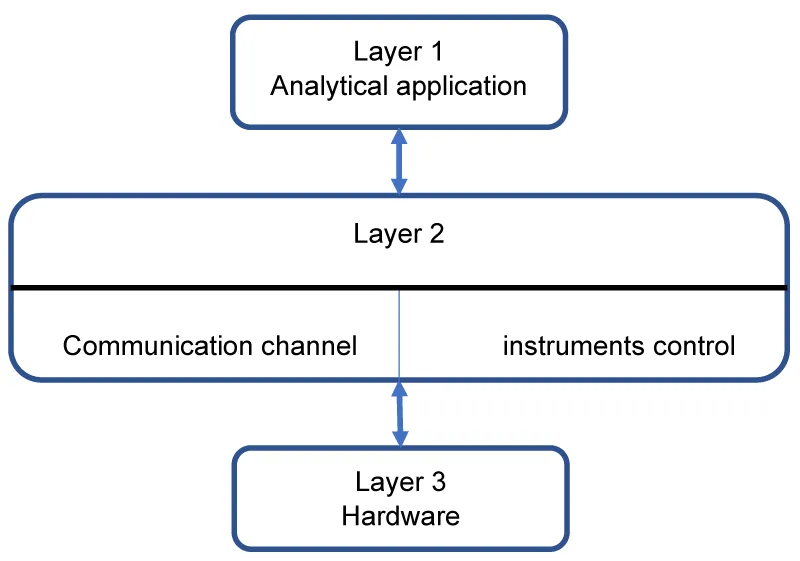
Figure 1: Layers configuration of the AutoAnalysis software package.
The application layer was developed on the Microsoft Windows platform (Win32), and the intermediate layer was implemented as dynamic link libraries (DLLs); moreover, a communication interface between it and the main application was defined.
- The bottom layer (layer 3) consists of the devices that are connected directly to the computer, interface cards and device drivers, manufacturer libraries for the control of the equipment, and programming the connection interfaces.
- The middle layer (layer 2) consists of communication channels and tools, i.e., it is subdivided into two parts. However, there are not two sub-layers, since each part is directly connected to the upper and lower layer. Communication channels are defined to provide the application with enough information about the actual scheme of hardware connections.
- The middle layer (layer 2) prevents the application (layer 1) from communicating directly with the hardware (layer 3). This is one of the objectives of layer 2: achieving independence of the hardware configurations from the application layer.
- Finally, there is the analytical application layer of concern. It includes the connected hardware configurations, methods, and data acquisition and processing, being the final user interface.
To work with the AutoAnalysis application, there is the following sequence of steps:
- Configuring the connected hardware: the user chooses the equipment and connections to be used and selects the most appropriate settings for the channels and instruments that are to come into play.
- Designing the analytical method to be used with the connected hardware: the programming tools of the software are used to develop the most appropriate method via the sequence of operations and decisions to reach expected results.
- Executing method to realize expected commands and data capture: It executes commands previously programmed with related instrumentation. When measuring instruments are started, corresponding data is acquired.
- Data processing: mathematical treatment of the previously acquired data such as curve smoothing (e.g. with the Savitzky-Golay algorithm), derivation, calibration or spectral refining. Data can also be exported to be processed with other software (e.g. Excel spreadsheet).
Starting with autoanalysis
The installation procedure is divided into two main stages, that is to say, the installation of the main application and that of the instruments and channels Dynamic Link Libraries (DLLs).
The basic requirements of AutoAnalysis are: operating system Windows 95/98/2000/NT/XP/Win7/Win10, Pentium, 512 MB RAM memory (better 1GB). 100 MB free hard disk (HD) space, a screen resolution of 800x600, and Internet Explorer 5.0 or superior.
The environment of the program is customized for each user, e.g., saving hardware configurations, methods, and data. Thus, a user must be selected before starting to use the program. A list of all registered users appears when opening the program (Figure 2). First, select your username and type your password.
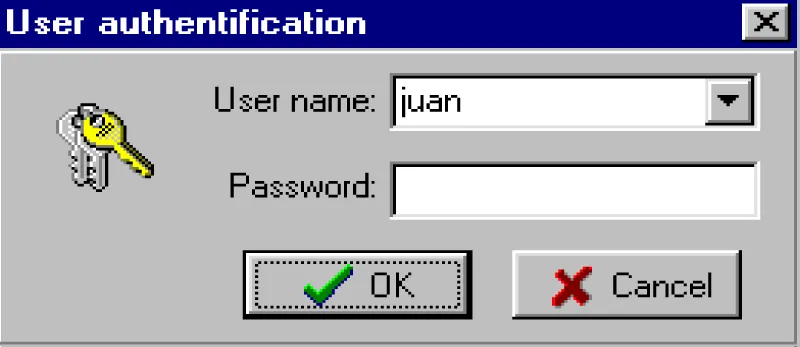
Figure 2: User authentication window.
For a new user, the program will ask for the data to create their account, for example: Full name, Password, and Password confirmation. Once a user has been created, so has its workspace. Thus, the program automatically creates a workspace in the installation directory, in the subdirectory Users, where there is another subdirectory for each user. If another directory is desired, select Don’t use default (Figure 3) and indicate the desired working directory. The button Browse can be used to find the desired directory. It is advisable not to change the working directory.
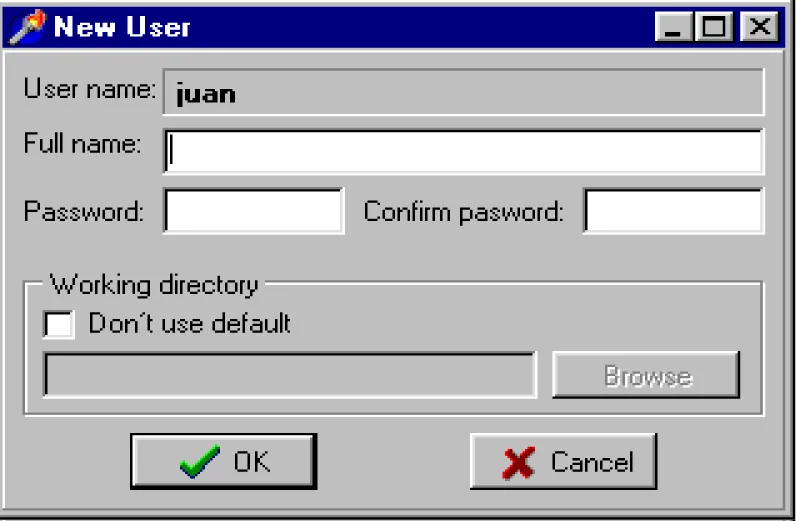
Figure 3: New user creation window.
AutoAnalysis main window has a column with an option bar (Figure 4). All functions of the software can be reached by clicking on the desired button.
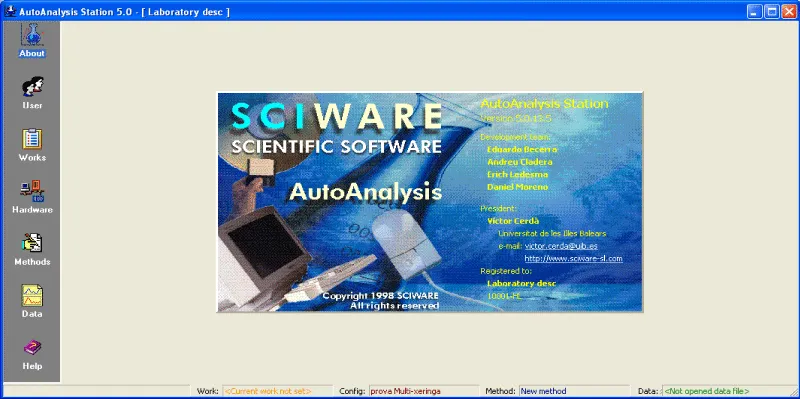
Figure 4: AutoAnalysis main.
Available options are:
- About: it shows information about the software.
- User: user edition tool (Name, password, workspace, …)
- Works: this section can be used to organize configurations, methods, and data.
- Hardware: connected Hardware configuration tool.
- Methods: methods edition and execution tool.
- Data: data processing tool.
- Help: online help function.
Each section functionality will be explained in detail below.
In the status bar, the configuration name, the metThe method, and the loaded data file appear.
Hardware configuration
The Hardware option is very flexible since it allows the settings for the body of equipment components connected to the computer to be loaded, saved, deleted, or changed at any time (Figure 5). In fact, the Configuration menu only displays the DLLs for the communication channels and instruments employed by the users in their particular applications. The software will only load into memory the DLLs explicitly selected by the user for a specific purpose, avoiding the computer’s memory overload.
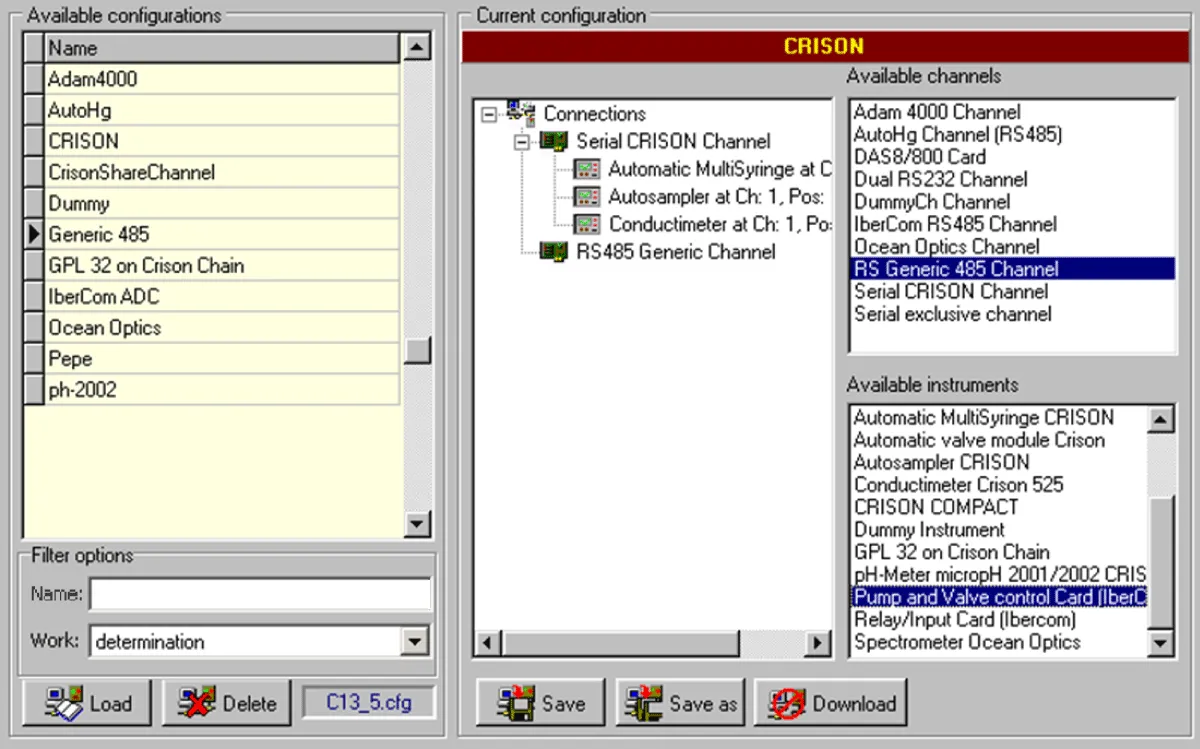
Figure 5: Hardware window.
When configuring the system, it is very useful to use a detailed block diagram for the process, including the channels to be used to connect the analytical equipment to the computer. First, the communication channels required are loaded. Then the instruments needed are implemented. Finally, the instruments concerned are linked with the communication channels present in the Configuration tree.
On the left appear the Available configurations previously saved by the user. These can be selected, and the following operations can be carried out:
- Load: load the selected configuration
- Delete: delete the selected configuration
- Filter by Work
When a configuration is selected, the name of the file where it is saved appears on thOn the right of the Delete button.
On the right side appears the Current configuration, which can be modified. This section is divided into three panels; on the left there is the tree where the channels and instruments linked to each channel appear; on the right side, at the top are displayed the list of Available channels, and at the bottom are displayed the Available instruments.
Available actions:
- Add new channels to the configuration: select the channel from the list of Available channels and drag it over Connections on the tree view.
- Link new instruments to a channel: select the channel from the list of Available instruments and drag it over the desired channel.
- Channels and instruments configuration, delete channels and disconnect instruments: select the channel or instrument you want to configure or delete and press the right button of the mouse; a menu will appear with the following options:
- Delete channel: it deletes the channel. It is only possible to delete a channe• Without linked instruments.
- Configure channel: it allows channel configuration.
- Disconnect instrument: disconnect instruments from the channel.
- Configure instrument: it allows instrument configuration.
- Help: online help.
- Save: save current configuration.
- Save as: save current configuration with another name. When saving an existing configuration with another name or a new one, the window shown in Figure 6 appears, and the configuration is associated with the current Work.
- Download: Download current configuration from memory.
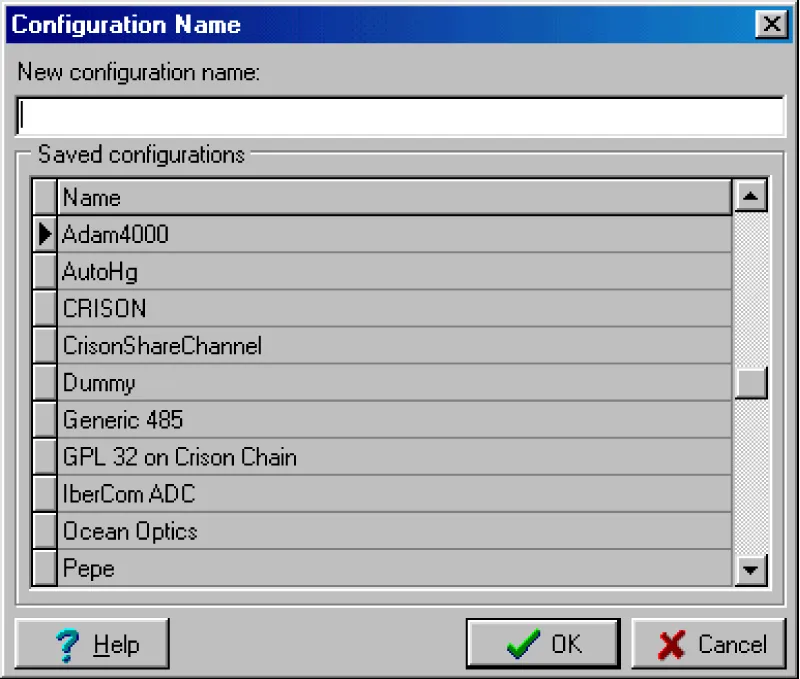
Figure 6: New configuration name window.
Example of a configuration of a SIA system with spectrophotometric detection
Figure 5.3 shows the AutoAnalysis configuration for an SIA system with spectrophotometric detection. The branches of the tree in the “current configuration” panel include a Crison serial communication channel and an Ocean Optics USB communication channel. Once the required communication channels are chosen, their operational settings (communication rate, word length, number of stop bits, control parity) can be selected in terms of the instruments to be employed. For some instruments, these settings are predDefined and cannot be modified.
Once all channels have been selected and configured, the miniaturized Ocean Optics CCD spectrophotometer is linked to its communication channel, and so are the Crison valve module and burette to theirs, e.g., first the valve (position 0) and then the burette (position 1). After these elements are strung, they can be individually configured, and operational characteristics such as the type of valve used (e.g., one selection valve and one injection valve), number of ports, syringe volumes, and burette steps can be selected.
Step-by-step description:
- Select the required instrumentation: e.g. a multisyringe burette, a CRISON selection valve and an Ocean Optics spectrophotometer.
- Connect and configure the channels: the two channels required are shown in Figure 7.
- Connect and configure the instruments: Figure 8 shows the final configuration.
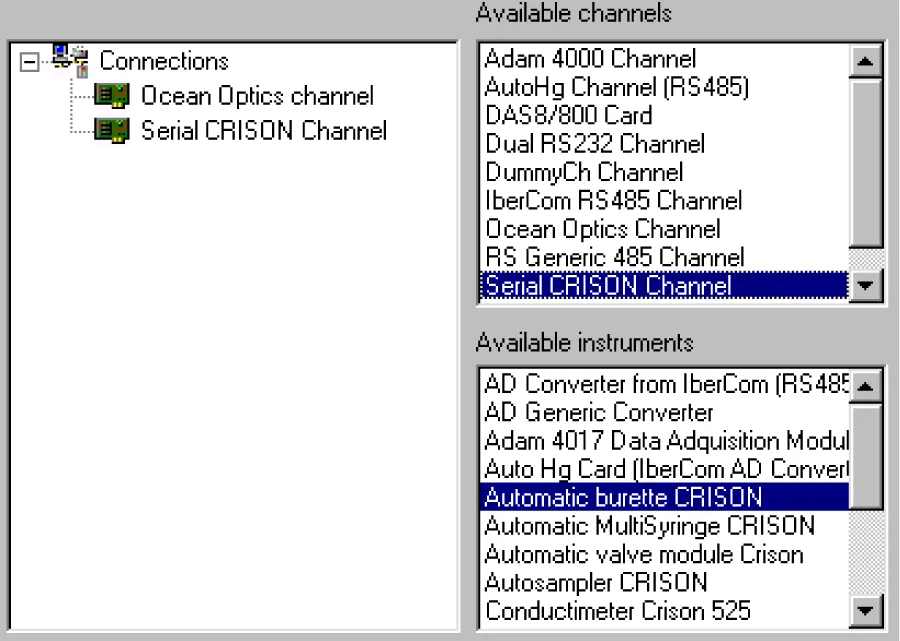
Figure 7: Configuration creation: Channel connection.
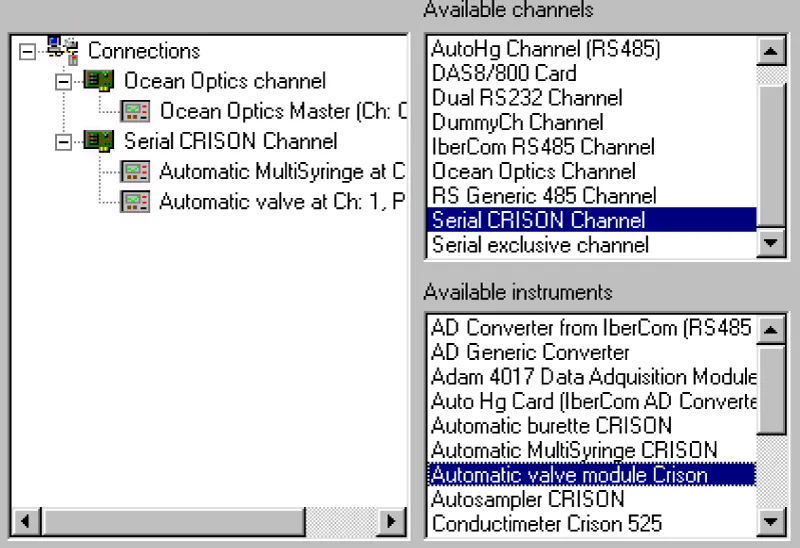
Figure 8: Configuration creation: Instruments connection.
AutoAnalysis is a very versatile software that allows combining different instruments and applying flow techniques in a very easy way. This means that in the same laboratory different researchers may use the same program applying different techniques. Once an analyst has learned how to use AutoAnalysis in a defined application, he will be able to use the same program for other applications in a very easy way. AutoAnalysis is useful not only for laboratory, but also for process analysis.
- Cerdà V, Ferrer L, Avivar J, Cerdà A. Flow Analysis: A Practical Guide. Elsevier, Amsterdam. 2014. Available from: https://dx.doi.org/10.1016/C2012-0-02414-3
- Maimó J, Far M, Estela JM, Cerdà V. Laboratory automation by means of cheap home microcomputers. 1. Simple automatic system for potentiometric titrations based on the Commodore VIC‑20. Química Analítica. 1986; 5: 245‑254.
- Becerra E, Cladera A, Cerdà V. Design of a very versatile software program for automating analytical methods. Lab. Robotics & Automation. 1999: 11: 131-140. Available from: https://doi.org/10.1002/(SICI)1098-2728(1999)11:3%3C131::AID-LRA2%3E3.0.CO;2-9
- Maya F, Estela JM, Cerdà V. Multisyringe ion chromatography with chemiluminescence detection for the determination of oxalate in beer and urine samples. Microchimica Acta. 2011; 173: 33-41. Available from: https://doi.org/10.1007/s00604-010-0511-1
- Horstkotte B, Duarte CM, Elsholz O, Cerdà V. Construction of a simple, economic, and versatile capillary electrophoresis system for coupling with syringe based analytical flow techniques. Global Journal of Analytical Chemistry. 2010: 1:262-274.
- Ferrer L, Estela JM, Cerdà V. Smart multisyringe flow injection system for the in-line concentration, dilution and direct determination of sulfide in water. Anal Chim Acta. 2006; 573-574:391-398. Available from: https://doi.org/10.1016/j.aca.2006.02.031