
More Information
Submitted: September 21, 2026 | Accepted: September 23, 2026 | Published: September 25, 2026
Citation: Sasi Kumar B, Sarath Chandra V. Real-Time Helmet Detection and Safety Compliance Analytics using Ultralytics YOLO11. J Artif Intell Res Innov. 2026; 2(2): 130-136. Available from:
https://dx.doi.org/10.29328/journal.jairi.1001026
DOI: 10.29328/journal.jairi.1001026
Copyright license: © 2026 Sasi Kumar B, et al.. This is an open access article distributed under the Creative Commons Attribution License, which permits unrestricted use, distribution, and reproduction in any medium, provided the original work is properly cited.
Keywords: Deep learning; Helmet detection; Intelligent transportation systems; Real-time object detection Safety compliance; YOLO11
Abbreviations: Helmet compliance is an important requirement in smart transportation and industrial safety settings because a failure in detection in time and/or errors can cause severe injuries to the head and loss of life. The performance of one stage DL detectors in real-time object detection in the challenging visual scenarios has been significantly improved recently. This study presents a real-time analytics platform based on Ultralytics YOLO that has been developed to identify and monitor helmet compliance and safety issues. The system is designed to reliably detect the occurrence of helmets and no-helmets in photos, movies, and live surveillance streams even in scenarios where there are small objects, occlusions and varying lighting conditions. Methodology contains considerable training of models, optimum preprocessing with a unified data set configuration, and preparation of datasets in the form of bounding boxes with YOLO format. Some of the detection models that are evaluated on standard performance measures that include mAP, recall, and precision are Faster R-CNN, YOLOv5s6u, YOLOv5x6u, YOLOv8, YOLOv9, and YOLOv11.Based on experimental results, YOLOv5s6u is more competitive in real-time conditions than two-stage detectors, as well as more recent versions of YOLO, with 93.0% mAP, 86.8% precision and 87.4% recall. The installed inference pipeline and the resulting computation of safety compliance statistics and live CCTV monitoring makes scalable and automated helmet enforcement in real-world settings possible.

Real-Time Helmet Detection and Safety Compliance Analytics using Ultralytics YOLO11
B Sasi Kumar1* and Sarath Chandra Veerla2
1School of Sciences and Humanities, SR University & Dr. V.R.K. Womens College of Engineering & Technology, Hyderabad, Telangana, India
2School of Science and Humanities, SR University, Warangal 506371, Hyderabad, Telangana, India
*Corresponding author: Dr. B Sasi Kumar, Principal & Professor, School of Sciences and Humanities, SR University & Dr. V.R.K. Womens College of Engineering & Technology, Hyderabad, Telangana, India, Email: [email protected]
Wearing of helmets is one of the key measures of construction sites safety, industrial, and transit system safety against head injuries [1]. The necessity of the rigid adherence to safety is explained by the fact that the head injuries are among the primary causes of occupational and traffic-related fatalities [2]. The increasing use of intelligent technologies of surveillance and monitoring is increasing the demand of automated systems that can detect the level of safety adherence in real time. These tools would enhance situational awareness, reduce the need to have human supervision, and provide valuable information to help in managing safety [3]. The advances in computer vision and artificial intelligence in recent times promise to automate the process of identifying safety equipment in an unfavorable environmental situation [4].
The traditional safety monitoring methods continue to have numerous shortcomings even with technological improvement [5]. In dynamic environments with varying item sizes, occlusions and illumination, manual inspection and traditional machine vision systems cannot always be used to verify compliance in real-time [6]. These restrictions reduce the effectiveness of the preventive activities and cause disproportionality in the implementation of helmet use policies [7]. Also, traditional systems tend to be incapable of balancing operational performance with sensor detection which limits their application in scenarios of continuous or extensive monitoring [8]. These challenges indicate that there is a severe flaw in the existing approaches to safety surveillance, which shows that there is a need to have reliable, versatile, and automated mechanisms that can be very stable even in diverse conditions.
The objective of this work is to develop an extensive scheme of helmet detection, which will be able to identify the use of a helmet in a diverse environment on its own [9]. The proposed solution will minimize human involvement, increase the accuracy and consistency of safety compliance monitoring. The project is supposed to create a scalable project which can perform effectively in diverse environmental conditions and object complexity by addressing the limitations of the currently existing methods. To enable proactive implementation of the safety process and informed decision-making, the framework is meant to provide real-time evaluation of helmet usage.
The researchers are significant in that they can transform the safety management practices in the social and workplace environments [10]. By providing the opportunity to monitor the situation more accurately and automatically, the framework can minimize the risk of head injury, increase compliance with regulatory requirements, and add to the overall workplace and transportation safety. Other benefits of such an implementation of a system are that it has broader implications on intelligent safety infrastructure, which can serve as a foundation to future integration with automated compliance analytics, smart city initiatives, and industrial Internet of Things. Finally, this study assists in the development of safer environments by means of technology monitoring and enforcing the use of protective gear.
In recent years, automated helmet identification systems have seen a lot of development, particularly, the application of DL-based object detection frameworks. Farooq, et al. [11] proposed a building site safety helmet identification system using YOLOv5 that had demonstrated good detection accuracy in controlled environments. Saputra, et al. [12] also evaluated the effectiveness of YOLOv8 in real-time helmet and safety vest detection and highlighted the importance of high frame-rate processing to implement it in dynamic scenarios. Prakash-Borah, et al. [13] showed the possibility of multi-task visual monitoring in traffic, extending the efficiency of the helmet as part of the number plate, by including the number plate detection. Altogether, these studies indicate the quality of the modern YOLO architectures in getting fast and precise detection under diverse circumstances.
Comprehensive studies of the formation and applications of YOLO can provide a deeper insight into the advantages and disadvantages of the frameworks. During their comprehensive investigation of the YOLO variations, Ali and Zhang [14] noted that, as the number of iterations increased, so did speed and recognition, however, small and partially obscured objects continued to be a problem. Kurniawan, et al. [15] when evaluating the use of YOLOv1012 in the small human identification case: the application of the object scale and ambient heterogeneity in the open-pit mining process, concluded that these two factors were significant contributors to detection robustness. Mao and Hong [16] affirmed in their review of the usage of YOLO applications to industrial applications that, despite the possibility of real-time detection, high accuracy could still not be ensured in complex backgrounds and when the illumination varied. These evaluations combined reveal the difference between the objectives of theoretical performance and the reality on the ground.
Relevant literature has explored new applications of the YOLO-based detection to safety and compliance monitoring beyond the industrial and construction context. Even though these solutions have shortcomings with regards to managing occlusion and variation in size of the objects of interest, the study of drone-based monitoring to detect unauthorized parking by Saini, et al. [17,20] showed that edge-based systems have the potential to be used to monitor objects in real-time. Rahman, et al. [18] demonstrated the significance of automated systems in the process of ensuring workplace safety, and in the creation of PPE-EYE, which is a DL-based system detecting the adherence to personal protective equipment, they also pointed to the difficulty of ensuring that the system will deliver consistent results across diverse environments. To enhance real-time helmet detection, Pandey, et al. [19] relied on synthetic data, which overcomes the insufficiency of training data at the cost of revealing the problems of domain adaption and generalization to complex real-life situations.
Despite these developments, some of the key gaps also exist. The existing studies are often focused on controlled environments or certain conditions and thus limit application to other scenarios. Also, there is occlusion, changing light conditions and small object situations, which may significantly hamper detection performance. Much remains yet to be discovered concerning the combination of data streams of different sources including live surveillance cameras. The current study will fill these gaps by developing a robust framework of helmet detection and safety compliance that is functional and applicable in different scenarios. It puts a great emphasis on scalable and automated monitoring which can help up safety enforcement in real time without necessarily relying on a controlled environment.
On the whole, the literature that was analyzed indicates that the current challenges persist to motivate further studies and demonstrates the opportunities of DL and YOLO-based techniques to identify the helmet and verify the safety standards [11–20]. The work contributes to the formation of more effective, scalable, and automated safety monitoring system as it helps close the gap between the strong performance under the conditions of the real work and high-accuracy detection during the controlled tests.
To make use of automated monitoring of helmet use in photos, videos, and live surveillance feeds, the suggested system provides an intelligent and real-time analytics platform on helmet identification and safety compliance. The approach proposes a DL-based detection pipeline, which improves safety enforcement in industrial and transportation environments by replacing automated visual analysis and supervision with manual. The data preparation process of helmet and no-helmet events is performed using bounding box annotations to ensure the accurate localization of the annotations. To perform the comparative learning and stability, the structure combines multiple models of detections, such as the two-stage detector Faster R-CNN and advanced one-stage detectors, such as YOLOv5s6u, YOLOv5x6u, YOLOv8, YOLOv9, and YOLOv11. The models are employed to get the semantic and spatial attributes necessary to detect small, partially obscured objects in numerous real-life situations. The uniformity of input processing and compatibility with models is facilitated by the single preprocessing approach. Also, the system implies a combined inference pipeline that may check live camera feeds, recorded movies and stationary images in real time. A web-based interface supports user authentication, submission of input, display of visual output, as well as safety compliance statistics. The aim of this strategy would be to provide an automated, scalable, and user-friendly program to monitor the ongoing compliance of the helmet.
The system architecture provides a thorough methodology of a helmet detention algorithm as it begins with a dataset processing that organizes the photos, annotations, and class labels whilst preserving the identical format of a YOLO bounding box. Several models of multiple object detection (Faster R-CNN and various versions of YOLO) are then trained on preprocessed data. The trained models are evaluated using metrics such as precision, recall and MAP. A Flask based interface also makes live picture and video postings, real-time inference, backend processing and presentation of detection results and performance information possible (Figure 1).
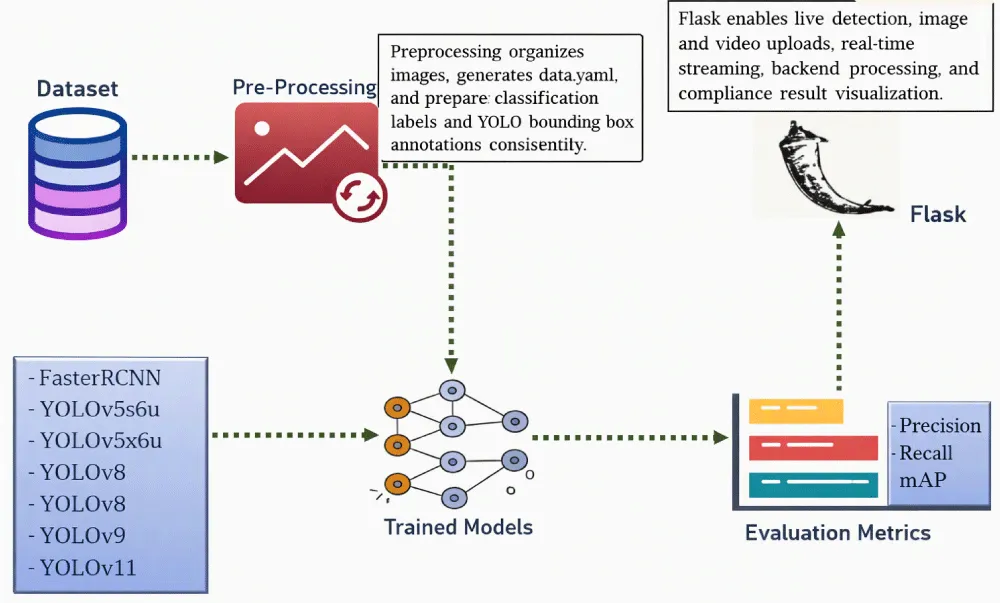
Figure 1: Proposed architecture.
Dataset collection
The study utilizes a well-chosen dataset of helmet detection that is prepared to item detection and has separate training and validation subsets. Whereas the validation set provides a representative sample to be used to evaluate the model, the training set is composed of photos in the YOLO format and corresponding label annotations. Each picture has examples of the cases both helmeted and non-helmeted, giving two classes totaling to one plus two classes considered. The dataset should be robust and generalized and is therefore made up of various visual situations including various illumination, occlusions, and a wide range of object sizes. It is best used to evaluate the performance of operations and the accuracy of detection in safety compliance usages due to its orderliness in labeling and diversity in the actual scenario.
Pre-processing
To ensure consistency, effectiveness, and reliable performance to ensure accurate helmet detection, the data is preprocessed methodically prior to model training. These are configuration of the devices, data transformation, structure feature, and the metric configuration.
Device configuration: In case there is also an option with a GPU acceleration, the system will prefer it when selecting the appropriate computational device. This step will ensure that the next stages of data processing and model training are implemented successfully by reducing training time and enabling real-time inference. The architecture is able to handle large data sets and complex neural networks topology, enable faster calculations, and stable memory functionality through the use of high-performance hardware. To achieve the highest possible efficiency of resources and ensure the repeatability and stability of results obtained in different hardware configurations, it is necessary to allocate devices correctly.
Dataset loading and transformation: There is a systematic way of loading and transforming images and annotations associated to them into a format that can be employed to evaluate and train the model. To ensure that all the data is consistent, this preprocessing phase involves the use of normalization, scaling the inputs, and standardization of image representations. This type of preparation is important in order to reduce uncertainty caused by differences in image size, color scale or resolution. Regular data formatting also enhances model convergence, learning features, and the object detection framework which is able to interpret visual information correctly in both training and inference.
Data representation and feature structuring: The images, the bounding boxes, and the labels of the classes are organized in a logical format in a way that they render the data compatible with the detection techniques. This step is necessary to enable the model to identify the spatial associations as well as semantic data that are related to each occurrence of an object. Proper representation makes it possible to take high accuracy between the inputs and target outputs, learning discriminative features, and facilitating effective batch processing. Feature structuring contributes to reliable prediction in complicated visual scenes, less label association errors, and strong training.
Metrics initialization: Performance tracking structures are established in order to systematically capture such assessment criteria as precision, recall, and mAP. This preprocessing ensures good reproducibility and comparability of experimental data of the model to model. By predefining these criteria, the system enables objective assessment of the effectiveness of the model and constant monitoring of the training progress of the training process. When structured performance tracking is added, reproducibility is enhanced, comparative analysis is facilitated as well as optimization strategies are directed to achieve high detection accuracy and reliability using diverse datasets.
Result storage preparation: The results of the experimental are stored with the help of a certain method according to which model identifiers are correlated with the evaluation measures related to them. This step ensures that there is systematization of data collection to be used in reporting and comparative analysis. Storing the results systematically enables benchmarking, simplifies the analysis of the post-training stage and allows tracking the performance of the models over time across multiple experiments. The approach enhances transparency, simplifies the process of replication and provides an evidence-based decision-making opportunity when selecting the most effective detection model to adopt through maintenance of orderly records.
Algorithms
Faster R-CNN: Faster R-CNN is a two-stage object detector which enables the precise localization of objects with specific boundaries after integrating the region proposal and object classification [21]. Despite the limited real-time capabilities in the case of computational overhead, its comprehensive capabilities in the extraction of features make it a powerful baseline in the detection endeavors, with a clear separation between helmeted and non-helmeted cases.
YOLOv5s6u: YOLOv5s6u is a one-stage detector with a lightweight and is used to detect small objects and is fast to infer. The processing of the full image in one pass and the use of spatial and semantic data is what ensures the reliability of the helmet detection at various distances and under partial occlusions with low latency [22].
YOLOv5x6u: The one stage detector with high capacity YOLOv5x6u is designed in case of large number of people and complexity [23]. Its more detailed and extended architecture offers a balance between detection accuracy and near real-time performance and enables features to represent the features and allow successful recognition in crowded or overlapping environments.
YOLOv8: YOLOv8 is a more advanced single-stage detector enhancement that has no anchor-free architecture and an improved feature aggregation. It is able to predict bounding boxes and classify with much better accuracy, and provides a way to achieve high-throughput performance on image and video processing and even provides a way to detect objects in diverse lighting conditions, motion blur, and harsh surveillance environments.
YOLOv9: High scores in generalization and robustness YOLOv9 is better at generalizing and reusing features by doing so with a sophisticated approach to gradient flow. Its design focuses on computing performance to achieve continuous monitoring and fast detection of safety violations in addition to its ability to detect consistently in various views, cluttered backgrounds, and occlusions.
YOLOv11: YOLOv11 introduces optimized feature fusion and consistency of predictions to achieve better results in detection in dynamic situations and real-life. Besides being able to handle crowd density and motion variance, it is better able to detect small visual patterns and gives consistent real-time operation that is suitable to automated compliance that comes with safety compliance applications.
Precision: Precision is the proportion of cases or samples that are correctly classified among those which are called positives. Thus, the precision can be determined with the help of the formula below (Table 1):
(1)
| Table 1: Performance Evaluation Table | |||
| ML Model | Precision | Recall | mAP |
| Faster-RCNN | 0.862 | 0.843 | 0.876 |
| Yolo V8 | 0.848 | 0.895 | 0.924 |
| Yolo v5s6 | 0.868 | 0.874 | 0.930 |
| Yolo v5x6 | 0.894 | 0.856 | 0.924 |
| Yolo v11 | 0.822 | 0.868 | 0.903 |
Recall: Recall is a measure of ML that evaluates the ability of a model to identify all relevant examples of a certain type. It provides data on the extent to which a model generates accurate predictions of instances of a specific category by the proportion of correctly predicted positive situations to the sum of actual positives.
(2)
mAP: MAP is one of the ranking quality statistics. It considers the number of relevant recommendations and their position in the list. MAP at K is calculated by means of arithmetic mean of the Average Precision (AP) at K of each user or query.
(3)
The performance evaluation of a few detection models shows that the meaning of the highest MAP belongs to the YOLOv5s6, with the variation in the precision and recall attracting the attention on the trade-offs between the accuracy and the reliability of detection.
Object identification models that are included and compared in the bar graph are Faster-RCNN, Yolo V8, Yolo v5s6, Yolo v5x6 and Yolo v11. Precision, Recall and mAP are provided and Yolo v5x6 scores highest total mAP (Figure 2).
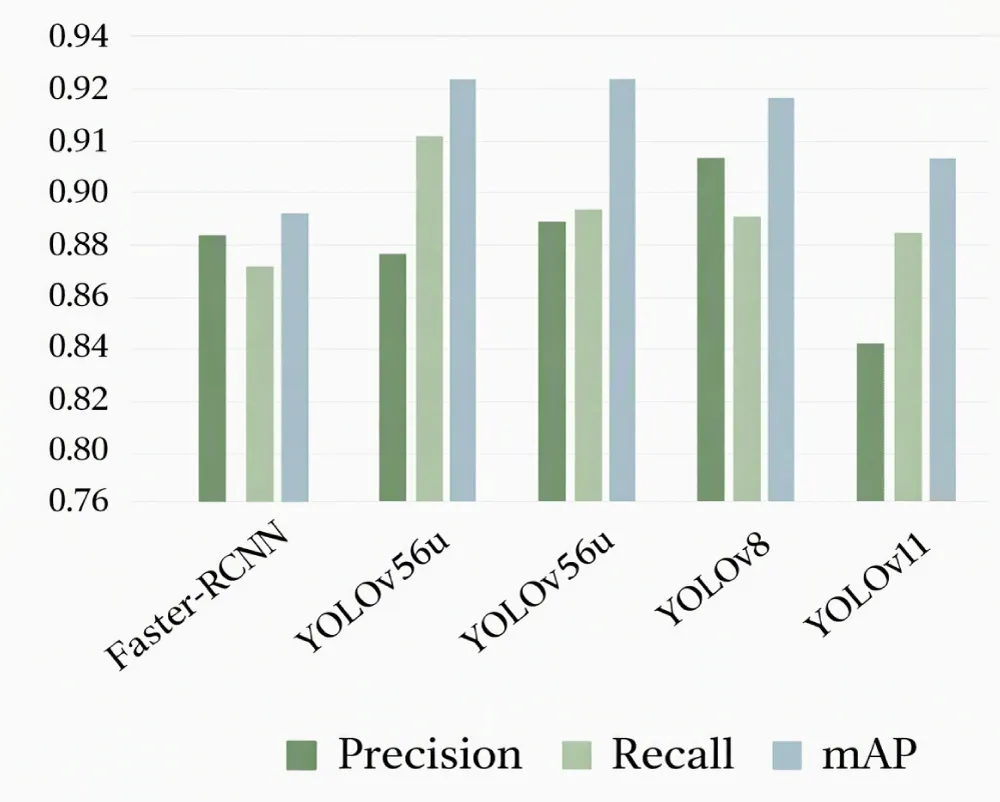
Figure 2: Comparison graph.
This interface has a feature of a helmet detection mechanism which is powered by YOLO. As illustrated by the pending upload of a helmet.mp4 file, users have the option of selecting or dragging and dropping image files and video files to be automatically reviewed on safety concerns (Figure 2.1).
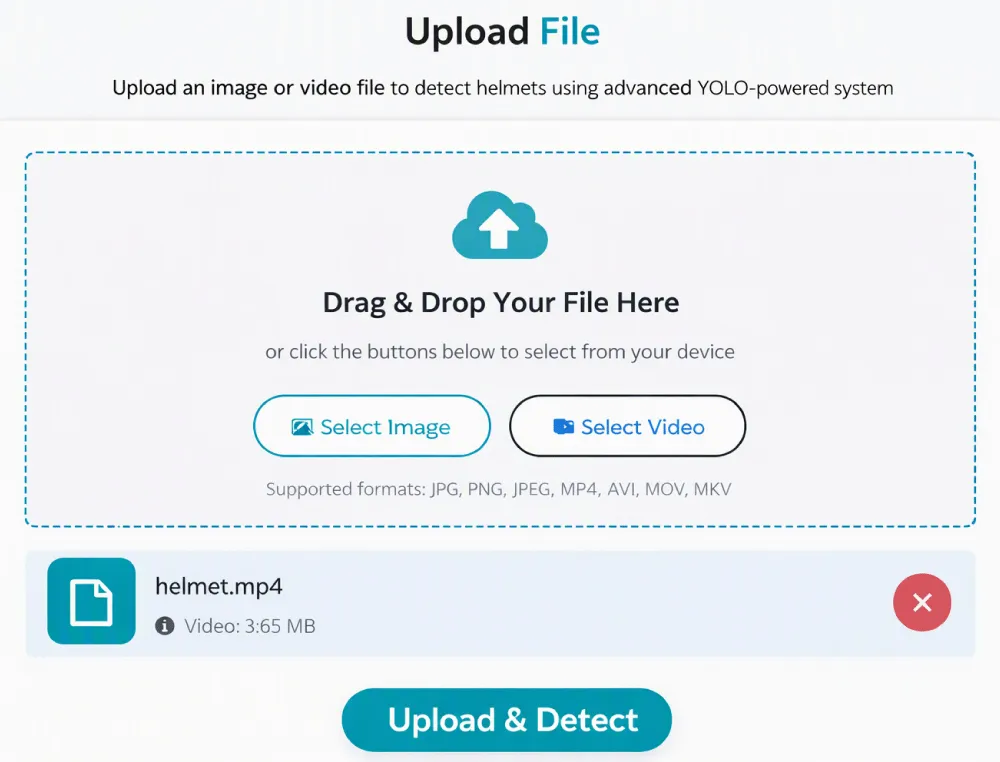
Figure 2.1: Upload the file..
This dashboard indicates the 38.5% helmet detection rate live. It identifies helmeted and helmetless riders using computer sight, and presents the data in the form of trends and bar graphs (Figure 3).
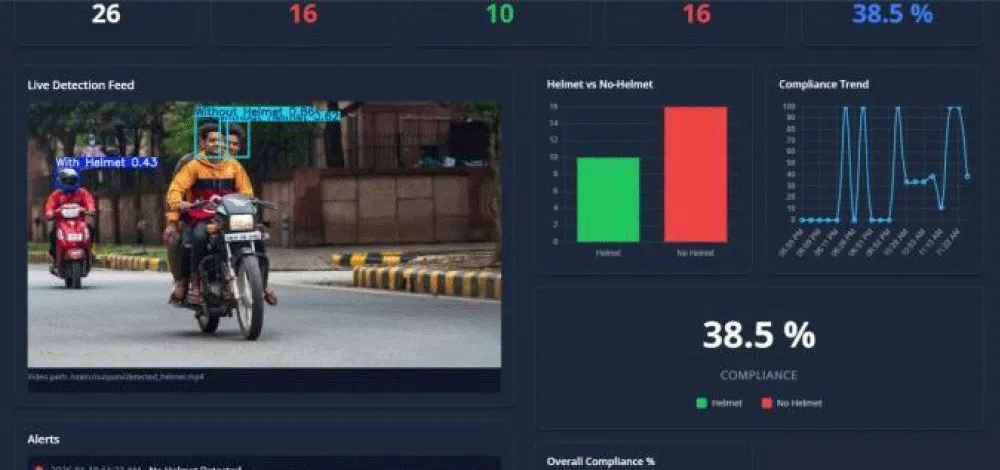
Figure 3: Predicted result.
The interface by this YOLO makes it possible to detect the helmets through file uploads. The system can now check the safety compliance and generate real-time analytics detection since the video, p2.mp4 (65.97 MB), is on the queue (Figure 4).
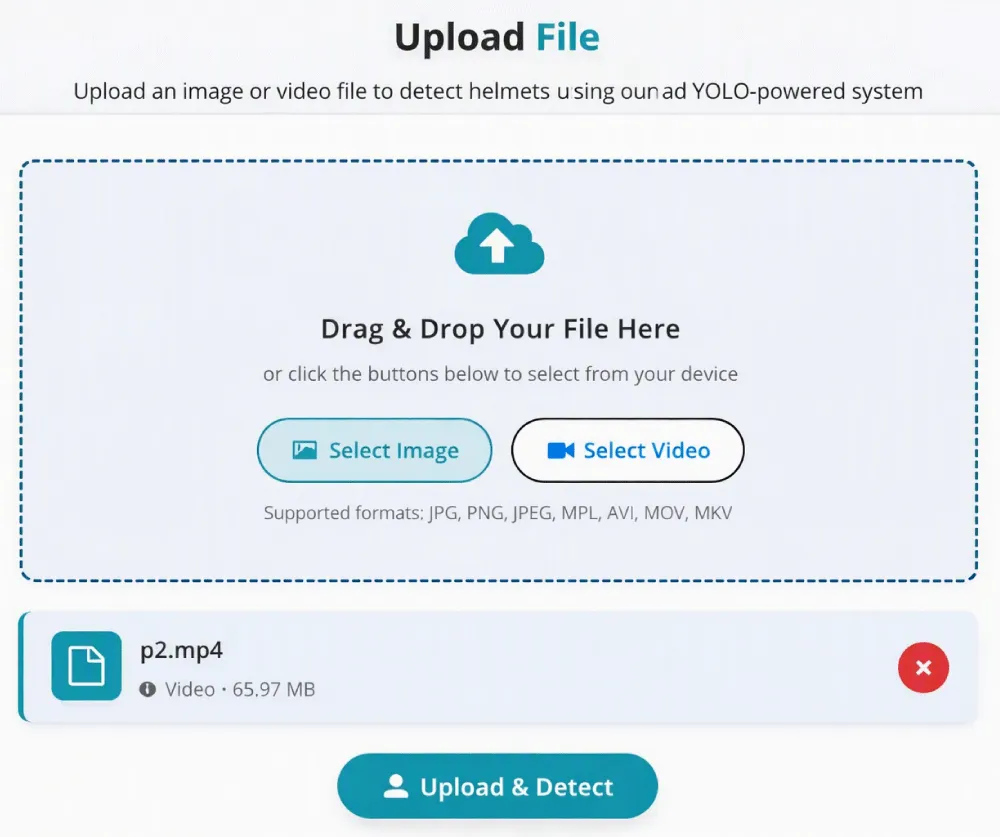
Figure 4: Upload the file.
This dashboard shows a poor 11.3% that is used to monitor compliance with safety. Some of the analytics used by the YOLO system to detect an individual who has no helmet in the live feed are a bar chart and a timeline (Figure 5).
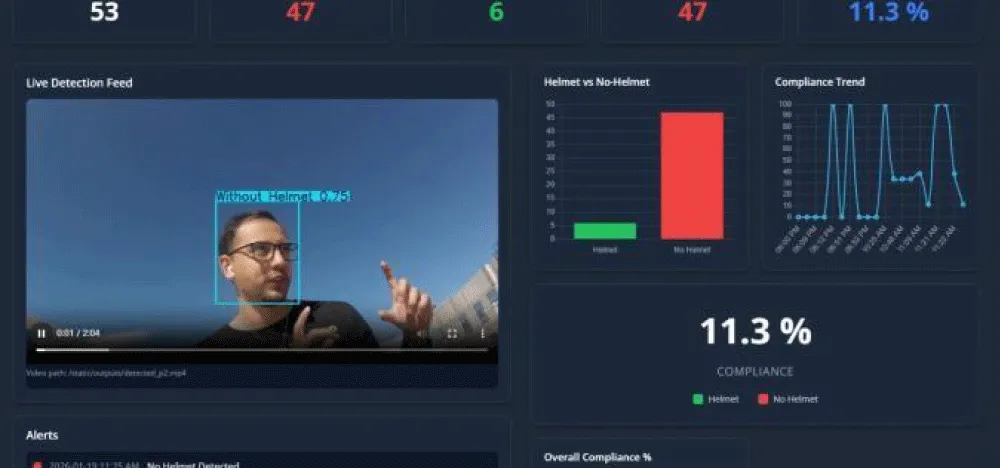
Figure 5: Predicted result.
The present study demonstrates the applicability of deep-learning-based object detection for automated helmet-compliance monitoring in real-time safety environments. The evaluated models included Faster R-CNN, YOLOv5s6, YOLOv5x6, YOLOv8, and YOLO11, enabling a comparative assessment of different object-detection architectures. Previous studies have demonstrated the application of YOLO-based approaches to helmet detection and safety monitoring in construction, transportation, and industrial environments [1,4,9,11].
According to Table 1, YOLOv5s6 achieved the highest reported mAP (0.930), whereas YOLOv5x6 achieved the highest precision (0.894) and YOLOv8 achieved the highest recall (0.895). Faster R-CNN achieved a precision of 0.862, recall of 0.843, and mAP of 0.876, while YOLO11 achieved a precision of 0.822, recall of 0.868, and mAP of 0.903. These findings indicate that no single model achieved the highest value across all three evaluation measures. Therefore, model selection should be based on the specific performance requirements of the intended safety-monitoring application.
The observed differences among the YOLO models are consistent with previous research demonstrating that model performance can vary according to architecture, object scale, environmental conditions, and application requirements. Kurniawan et al. highlighted the importance of object scale and environmental heterogeneity when evaluating YOLO architectures under real-world conditions [3]. Similarly, Ali and Zhang discussed the evolution of the YOLO framework and differences in its performance across applications and model generations [14]. These findings indicate that newer model versions should not automatically be interpreted as superior under every dataset or deployment condition.
The performance of YOLOv5s6 observed in the present study is also relevant to previous helmet-detection research. Farooq, et al. investigated YOLOv5 for real-time safety-helmet detection at construction sites [11], while Saputra et al. evaluated YOLOv8 for real-time helmet and safety-vest detection [4]. Prakash-Borah et al. further demonstrated the application of computer vision for real-time helmet detection together with number-plate extraction [5]. Collectively, these studies support the suitability of YOLO-based architectures for automated helmet and safety monitoring, although differences in datasets, environmental conditions, and evaluation protocols can lead to different model-performance outcomes.
The present findings should also be considered in relation to the challenges associated with real-world deployment. Variations in illumination, occlusion, object size, and complex backgrounds can affect object-detection performance. Previous investigations of YOLO architectures have identified such environmental and object-level factors as important considerations for robust detection [3,14,16]. In addition, synthetic-data-based helmet detection has been explored to address limitations in training data; however, generalization from synthetic or controlled data to complex real-world environments remains an important consideration [10].
The application of YOLO-based systems to safety compliance has also been demonstrated in industrial environments. Alhaila, et al. investigated a YOLO-based helmet-detection system for safety compliance in the oil and gas industry [9]. More recently, Rahman et al. proposed PPE-EYE, a deep-learning approach for personal protective-equipment compliance detection [18]. These studies support the broader applicability of computer-vision-based systems for automated monitoring of safety-equipment compliance.
The web-based implementation presented in the current study provides an additional practical component by enabling image and video inputs and displaying the corresponding detection results. However, the percentages displayed by the dashboard should be clearly distinguished from the formal precision, recall, and mAP values reported in Table 1. The manuscript should specify the denominator, calculation procedure, dataset, and interpretation of the reported helmet-detection percentage before these values can be directly related to the standard model-performance metrics.
Another important consideration is the evaluation protocol. The manuscript describes training and validation subsets but does not clearly report an independent test-set evaluation. Furthermore, confidence intervals, standard deviations, repeated experimental results, or other measures of variability are not presented. Consequently, relatively small numerical differences between the evaluated models should be interpreted cautiously. Future evaluation should include an independent test set and, where feasible, repeated experiments or uncertainty estimates to establish the robustness of the observed differences.
The findings also require clarification regarding the role of YOLO11 in the present study. Although previous research has investigated YOLO11 for helmet-violation detection and other real-time visual-analysis applications [1,10], the numerical results presented in the current manuscript do not identify YOLO11 as the highest-performing model. Instead, YOLOv5s6 has the highest mAP (0.930), YOLOv5x6 has the highest precision (0.894), and YOLOv8 has the highest recall (0.895). Therefore, the title, Results, Discussion, and Conclusion should consistently reflect these reported findings rather than describing YOLO11 as the overall best-performing model.
Overall, the results support the feasibility of YOLO-based object detection for automated helmet-compliance monitoring. The findings are consistent with previous research on helmet detection, safety-equipment monitoring, and YOLO-based computer-vision applications [1,4,9,11,18]. Further studies should evaluate the proposed system using larger and more diverse datasets containing variations in illumination, weather, camera viewpoints, occlusion, object scale, and deployment environments. Such evaluation would provide stronger evidence regarding the generalizability and practical reliability of the proposed safety-compliance frameworks
The effectiveness of modern one-stage DL detectors in automated safety surveillance in dynamic settings is implied by the developed real-time helmet detect and safety compliance analytics system. The pipeline is able to efficiently handle pictures, prerecorded films and live surveillance videos under typical conditions of real-world, such as occlusion, motion blur and change in size, to give accurate localization and classification of helmet and no-helmet cases [24]. Not fully as a compliance analytics, the concept of integrated compliance analytics extends to provide more practical usability, such as the real-time statistics of helmet usage and number of violations, to be useful in making decisions related to safety enforcement. YOLO11 is the best performing model based on performance measures with a mAP of 93.0, precision of 86.8, and a recall of 87.4. This demonstrates great detection reliability and performs in-time inference [25]. This balance between precision and computational efficiency, without compromising responsiveness, allows it to be easily deployed in edge devices and centralized monitors. The live streaming and the visualization of statistics offered by the web-based interface simplify the continuous safety assessment and ensure non-technical users can use it. Overall, the findings can be validated by the fact that Ultralytics YOLO-based detectors may be used in scalable helmet compliance monitoring. The framework is placed as the powerful solution to industrial safety scenarios and smart transportation systems because of the achieved precision of detection and real-time analytic capability, evoking proactive preventive measures of accidents and the improvement of compliance with the occupational safety.
The future work can be focused on increasing the scalability and strength of the helmet detection and compliance analytics framework. To enhance the level of performance, transformer-based detection heads can be combined with lightweight attention methods to detect small and heavily hindered objects. The dataset would be further supplemented by more weather conditions, night time deployment, and multi-view camera view in order to improve generalization across real-world deployments. With embedded and roadside devices, a latency reduction of edge-based AI using TensorRT and quantization is achievable. Multi-object tracking will make it possible to analyze identity assignments and violations in a persistent way. The system can be also extended to a full-scale workplace and traffic safety solution, including the capability to recognize other PPE, including the use of gloves and other safety vests.
- Ashuri RF, Pramesti D, Fakhrurroja H. Helmet violation detection system based on YOLO11 and EfficientNet for real‑time traffic monitoring. In: 2025 Int Conf Inf Commun Technol (ICoICT). IEEE; 2025 Jul. p. 1‑6. Available from: https://doi.org/10.1109/ICoICT66265.2025.11193031
- Saini T, Guha M, Bairwa SK, Dutt V, Singh K, Singh D. Drone‑UP: Drone‑based unauthorized parking detection method for edge‑devices. In: 2025 Int Joint Conf Neural Netw (IJCNN). IEEE; 2025 Jun. p. 1‑7.
- Kurniawan A, Arifin S, Machbub C, Aulia AI, Siregar AM, Faisal M. Real‑time detection of small humans in open‑pit mining: evaluating YOLOv10‑v12 architectures under real‑world conditions. 2025. Available from: https://doi.org/10.36227/techrxiv.176621143.31487688/v1
- Saputra MA, Munastha KA, Mulyono TT, Fitriadi B, Setiawan T, Lestari N. Performance analysis of real‑time safety vest and helmet detection using YOLOv8. In: 2024 18th Int Conf Telecommun Syst Serv Appl (TSSA). IEEE; 2024 Oct. p. 1‑5.
- Prakash‑Borah J, Devnani P, Kumar‑Das S, Vetagiri A, Pakray P. Real‑time helmet detection and number plate extraction using computer vision. Comput Sist. 2024;28(1):41‑53.
- Ashuri RF, Pramesti D, Fakhrurroja H. Helmet violation detection system based on YOLO11 and EfficientNet for real‑time traffic monitoring. In: 2025 Int Conf Inf Commun Technol (ICoICT). IEEE; 2025 Jul. p. 1‑6.
- Nair GG, Chengappa BA, Santosh A, Ayush J, Sabherwal S, Sinha A. High‑precision traffic accident detection using YOLOv11 model and image processing with deep learning techniques. In: Natl Conf Comput Vis Pattern Recognit Image Process Graph. Springer Nature Switzerland; 2025 Jul. p. 376‑84.
- Rarità L, Pipino C, Marciano C, Raia A. A possible approach to integrate computer vision and blockchain for construction safety management. Procedia Comput Sci. 2025;274:654‑63. Available from: https://doi.org/10.1016/j.procs.2025.12.064
- Alhaila S, Almelhem I, Alsnafi A, Alameerah M, Alrumaidhi K, Nadeem M. YOLO‑based helmet detection system for safety compliance in oil and gas industry. In: 2024 5th Int Conf Ind Eng Artif Intell (IEAI). IEEE; 2024 Apr. p. 16‑23.
- Pandey KK, Singh SK, Singh JN. Real‑time helmet detection using synthetic dataset and YOLOv11. In: Int Conf Data Anal Manag. Springer Nature Switzerland; 2025 Jun. p. 451‑63.
- Farooq MU, Bhutto MA, Kazi AK. Real‑time safety helmet detection using YOLOv5 at construction sites. Intell Autom Soft Comput. 2023;36(1).
- Saputra MA, Munastha KA, Mulyono TT, Fitriadi B, Setiawan AT, Lestari N. Performance analysis of real‑time safety vest and helmet detection using YOLOv8. In: 2024 18th Int Conf Telecommun Syst Serv Appl (TSSA). IEEE; 2024 Oct. p. 1‑5.
- Prakash‑Borah J, Devnani P, Kumar‑Das S, Vetagiri A, Pakray P. Real‑time helmet detection and number plate extraction using computer vision. Comput Sist. 2024;28(1):41‑53.
- Ali ML, Zhang Z. The YOLO framework: a comprehensive review of evolution, applications, and benchmarks in object detection. Computers. 2024;13:336.
- Kurniawan A, Arifin S, Machbub C, Aulia AI, Siregar AM, Faisal M. Real‑time detection of small humans in open‑pit mining: evaluating YOLOv10‑v12 architectures under real‑world conditions. Authorea Preprints. 2025.
- Mao M, Hong M. YOLO object detection for real‑time fabric defect inspection in the textile industry: a review of YOLOv1 to YOLOv11. Sensors (Basel). 2025;25(7):2270. Available from: https://doi.org/10.3390/s25072270
- Saini T, Guha M, Bairwa SK, Dutt V, Singh K, Singh D. Drone‑UP: Drone‑based unauthorized parking detection method for edge‑devices. In: 2025 Int Joint Conf Neural Netw (IJCNN). IEEE; 2025 Jun. p. 1‑7.
- Rahman A, Ahmed MS, AlBugami KN, Alabbad AY, AlFantoukh AA, Alshaikhahmed YH, et al. PPE‑EYE: a deep learning approach to personal protective equipment compliance detection. Computers. 2026;15(1):45. Available from: https://doi.org/10.3390/computers15010045
- Pandey KK, Singh SK, Singh JN. Real‑time helmet detection using synthetic. In: Proc Data Anal Manag ICDAM 2025. Vol 3. 2025. p. 451.
- Saini T, Guha M, Bairwa SK, Dutt V, Singh K, Singh D. Drone‑UP: Drone‑based unauthorized parking detection method for edge‑devices. In: 2025 Int Joint Conf Neural Netw (IJCNN). IEEE; 2025 Jun. p. 1‑7.
- Chheda M, Kapoor N, Desai K, Gupta RK. Automatic motorcyclist helmet rule violation detection using YOLOv5. In: 2024 Asian Conf Intell Technol (ACOIT). IEEE; 2024 Sep. p. 1‑7.
- Tirwa M, Joshi P, Sinha AP, Dolma Y, Singh M. A study to assess the awareness and practices of helmet use among two‑wheeler riders in Delhi. Indian J Neurotrauma. 2023;20(1):24‑8.
- Aboah A, Wang B, Bagci U, Adu‑Gyamfi Y. Real‑time multi‑class helmet violation detection using few‑shot data sampling technique and YOLOv8. In: Proc IEEE/CVF Conf Comput Vis Pattern Recognit. 2023. p. 5350‑8.
- Zhou F, Zhao H, Nie Z. Safety helmet detection based on YOLOv5. In: 2021 IEEE Int Conf Power Electron Comput Appl (ICPECA). IEEE; 2021 Jan. p. 6‑11.
- Wu Z, Qin J, Xiang X, Tan Y. YOLO‑CBF: optimized YOLOv7 algorithm for helmet detection in road environments. Electronics. 2025;14(7):1413. Available from: https://doi.org/10.3390/electronics14071413