
More Information
Submitted: April 01, 2026 | Accepted: April 13, 2026 | Published: April 15, 2026
Citation: Hooda DS. A Review on Fuzzy Information Measures and Their Generalizations. J Artif Intell Res Innov. 2026; 2(1): 036-043. Available from:
https://dx.doi.org/10.29328/journal.jairi.1001016
DOI: 10.29328/journal.jairi.1001016
Copyright license: © 2026 Hooda DS. This is an open access article distributed under the Creative Commons Attribution License, which permits unrestricted use, distribution, and reproduction in any medium, provided the original work is properly cited.
Keywords: Fuzzy set theory; Fuzzy entropy; Fuzzy information measures; Fuzzy divergence; Uncertainty modeling; Membership function

A Review on Fuzzy Information Measures and Their Generalizations
Hooda DS*
Former PVC, Kurukshetra University, Ex-Dean (R) and HOD(Maths), JUET, A B Road, Raghogarh, Dist. Guna-4732269-MP, India
*Corresponding author: DS Hooda, Former PVC, Kurukshetra University, Ex-Dean (R) and HOD (Maths), JUET, A B Road, Raghogarh, Dist. Guna-4732269-MP, India, Email: [email protected]
Ambiguity and vagueness in a set X are described in uncertain situations by fuzzy set theory. When we process information, fuzziness occurs because of our thinking and decision-making. In the present communication, a fuzzy set and its properties are narrated. Operations on fuzzy sets and some important basic concepts are discussed. Fuzzy information measures are developed, and their similarity and dissimilarity with probabilistic information measures are discussed. Measures of fuzzy divergence and fuzzy information improvement are also introduced and discussed in detail.
Zadeh [1] was the first to generalize crisp set theory as fuzzy set theory, which describes many impossible situations in the real world. It is a well-known fact that an important role in the development of human thinking with proper language is played by impossible and imprecise classes.
Fuzzy set theory explains the concepts of ambiguity, and those are quantified and analyzed properly. Thus, fuzzy set theory research and its application have gained popularity in different areas during the last six decades. Subsequently, the fuzzy set theory has been found useful in decision-making theory, medical diagnosis, pattern recognition, control theory, etc.
Thus, the theory of fuzzy sets gives perception based on linguistic information, while the theory of probability only provides uncertainty based on the numerical information of an event. Thus, there are two types of information: the first one is numerical, e.g., Sita is 27, and the second is linguistic. Hence, we obtain important results in the modeling of uncertainty, vagueness, and impression, which characterize and increase human knowledge.
Fuzziness is also found in uncertainty, in our judgment, in our words, and in the method of processing information. Thus, randomness and fuzziness are conceptually and theoretically different [2].
Actually, fuzziness and randomness are two different notions; the first one describes ambiguity, and the second one describes the occurrence of uncertainty in an event. The concepts of probability theory and fuzzy logic described by Zadeh [3] are complementary to one another and not competitive. Hence, we can conclude that the concepts of probability and fuzzy logic are two different but complementary to each other.
1.1 Definitions of crisp set and fuzzy set
Crisp set: A crisp set is a collection of things that satisfies a requisite property, or a set is called a crisp set if every member either belongs to or does not belong to the set. For example, let the characteristic function be defined as, then.
It is called a crisp set. If in the classical set, the characteristic function has the values either 0 or 1, then the set is also called a crisp set. Finally, the crisp set is a collection of all those members of the universe of discourse for which or 0.
Fuzzy set: Zadeh [1] defined a fuzzy set A on a universe of discourse as given below:
, (1.1)
Where is the membership function of, and it describes the degree of . In case it is valued in {0, 1}, then it is called the characteristic function of a crisp set A.
Membership function X is also called the characteristic function of a fuzzy set, and Singpurwalla and Booker [4] have explained its role in probability measures of fuzzy sets.
Example 1: ‘Youthfulness’ of people of different ages is an example of the concept of fuzzy sets. Further, let X be the set of people, and a fuzzy subset of young A is described and denoted as given below:
.
Table 1.2: Numerical values of membership function Y(x)
| Person | Age(x) | Membership Value Y(x) |
| A | 20 | 1.00 |
| B | 26 | 0.90 |
| C | 30 | 0.50 |
| D | 34 | 0.10 |
| E | 36 | 0.00 |
The above example is explained graphically as given below:
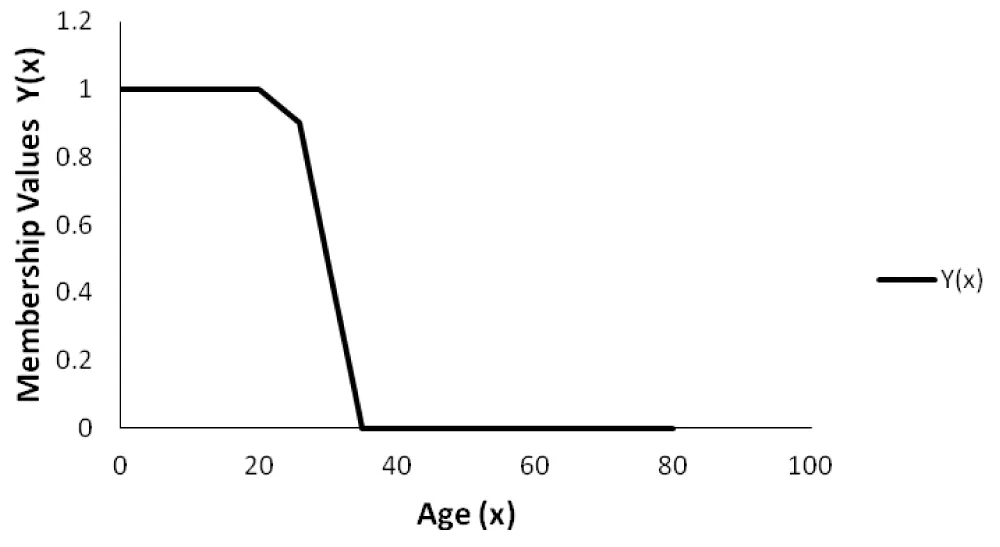
Figure 1: Representation of the Membership Values Y(x).
1.2 Fuzzy set operations
Generally, we extend crisp operations from the fuzzy set operations. These are just the extensions of crisp concepts with the condition that the fuzzy sets have only 1 and 0 as the membership values. We enlist these operations as given below, and for defining them, it is assuming that and are two fuzzy subsets of the universe of discourse with membership functions, respectively.
Zadeh [1] gave the following notions related to fuzzy sets:
a. Containment: for all .
b. Equality: for all .
c. Complement: Complement of for all .
d. Union: Union of and for all .
e. Intersection: Intersection of and for all .
f. Product: AB = Product of and for all .
g. Sum: A+B = and Sum of A and for all .
1.3 Fundamental properties of fuzzy sets
The fundamental properties of fuzzy sets are as follows:
(i) Idempotent law:
.
(ii) Commutative law:
.
(iii) Associative law:
.
(iv) Distributive law:
.
(v) Absorption law:
.
(vi) Zero Law:
.
(vii) Identity Law:
.
(viii) De Morgan’s law:
.
Next, some important definitions that are frequently used in fuzzy set theory are given below:
(a) Two equal fuzzy sets: Two fuzzy sets A and B are said to be equal if and only if
(b). Standard fuzzy sets: Fuzzy sets are said to be standard if .
(c). Support of a fuzzy set: Let be the universal set and A be its subset, then an ordinary set defined as the set of elements whose degree of membership in A is greater than 0 is called the support of subset A and is written as
.
Various authors have made several attempts to quantify the uncertainty associated with fuzzy sets. Zadeh [5] introduced the concept of fuzzy entropy and also called it a measure of fuzziness. Fuzzy entropy is also known as fuzzy information measure, which is used for measuring the fuzzy information, and thus it is a very important concept.
The measure of the fuzziness as defined has found wide applications in many fields, e.g., image processing, speech recognition, pattern recognition, bioinformatics, fuzzy aircraft control, feature selection, decision making, medical diagnosis, etc. Fuzzy measures estimate the average ambiguity in fuzzy sets in some physical phenomena.
Next, the properties that this measure satisfies are discussed in detail. There is no ambiguity about whether an element belongs to the set or not if the fuzziness of a crisp set using any measure is zero. Similarly, if in a set X, holds for every x, then the set is called maximally ambiguous. Thus, the ambiguity regarding the belongingness of the argument in the fuzzy set decreases accordingly, and the fuzziness contained would be maximum.
A fuzzy set A* is called a sharpened version of A if the following condition is satisfied:
If we consider A*, a sharpened version of A, the fuzziness version shall decrease because sharpening reduces ambiguity. Thus, the fuzziness measure of a set and its complement is equal, and that is another intuitively desirable property.
Example: If the ambiguity present in the sets TALL and NOT TALL (note that NOT TALL doesn’t mean that it is SHORT) is the same. However, it may be noted that TALL is not necessarily SHORT. Thus, and give the same degree of fuzziness for all .
Based on the above-mentioned properties, De Luca and Termini (1972) introduced an axiomatic structure of the measure of fuzzy entropy as given below:
(2.1)
The following four properties (P1 to P4) are essentially satisfied to be a measure of fuzziness H(A) of a fuzzy set A:
(P1) H(A) is minimum if and only if A is a crisp set, i.e.,
or 1 for all
(P2) H(A) is maximum if and only if A is the most fuzzy set, i.e.,
for all
(P3) , which is a sharpened version of A,
where a fuzzy set A* is the sharpened version of A if the following conditions are satisfied:
, if ; and
, if ; .
(P4) , where is the complement of A.
It is worth mentioning that in case they are members of the universe of discourse, then all lie between 0 and 1, because these are not probabilities and so their sum is not essentially unity.
However, ; is a probability distribution.
Kaufmann (1980) defined entropy of a fuzzy set A having n support points by
(2.2)
The fuzzy entropy measures uncertainty due to the fuzziness of information refer to Kapur [6] and probabilistic entropy was defined to measure the uncertainty contained in probability distribution. Thus, by using the probability theory works in fuzzy environment helps to deal with uncertainties which arise within the same problem.
Pal and Pal [7] introduced the fuzzy information measure with an exponential function and that later on became the concept of the rth order entropy of a fuzzy set introduced by him. Thereafter, a survey was made Bhandari and Pal [8] on information measures on fuzzy sets and characterized some new measures of fuzzy information. Kapur [6], Prakash and Hooda [9,10] also made a study of new measures of fuzzy information. Hooda and Bajaj [11] have also studied some various generalized additive and non-additive fuzzy information measures.
Later on, some sub additive trigonometric measures of fuzzy information were defined and characterized by Hooda and Jain [12] Hooda and Vivek [13] studied fuzzy information measures and their generalizations with applications in detail. They enumerated the similarities and dissimilarities between the two types of measures namely; fuzzy information measure and probabilistic information measures.
Next those several measures which were proposed and characterized to measure the degree of difference between two fuzzy sets are considered. Since a measure of fuzzy divergence is the difference between two fuzzy sets; therefore, we can conclude that the fuzzy divergence measure is nothing but the difference between two fuzzy sets.
Analogous to Kullback and Leibler [14]’s measure of divergence, Bhandari and Paul [8] introduced the following divergence measure between two fuzzy sets A and B of universe of discourse having the membership values and :
, (3.1)
It can be verified that measure 3.1 satisfies the following conditions:
(i)
(ii)
(iii) is a convex function of A and B.
The fuzzy symmetric divergence measure as given below was also defined by Bhandari and Pal [15].
(3.2)
Another axiomatic definition of a divergence measure for fuzzy sets was considered an important content in fuzzy mathematics. Since the more attention was invited to research on divergence measures between fuzzy sets; therefore, some generalized measures of fuzzy divergence were proposed and studied.
Later on, Shang and Jiang (1997) modified the fuzzy divergence measure of Bhandari and Pal [8] as given below:
(3.3)
Keeping in view the exponential fuzzy entropy of Pal and Pal [7], the following fuzzy information measure of discrimination of A against B was proposed by Fan and Xie (1999):
(3.4)
Let X be a set of universe of discourse F(X) and is the set of all fuzzy subsets, then a mapping is a divergence measure between fuzzy subsets iff the following axioms hold for each :
‘
where D(A : B) is assumed as non-negative.
Thereafter, the special classes of divergence measures were studied by various authors and were used as the link between fuzzy and probabilistic uncertainty. Their particular cases were also studied widely.
Corresponding to Havada-Charvat [15], a fuzzy divergence measure was defined and studied by Hooda [10] as given below:
(3.5)
Parkash et al. [9] proposed and characterized the following fuzzy divergence:
(3.6)
Parkash, et al. [16] also proposed the following measure:
(3.7)
Bajaj, et al. [11] generalized the fuzzy divergences given by Sharma and Mittal (1977) as mentioned below:
(3.8)
and
(3.9)
Here we define some of symmetric and non-symmetric fuzzy divergence measures analogous to probabilistic divergence measures and inequalities. These were studied by Singh and Tomar [17,18] who also studied a number of refinements of inequalities among fuzzy divergence measures
Corresponding to Taneja (2008)’s fuzzy divergence measure, Arithmetic-Geometric divergence measure is given by
(3.10)
A generalized triangular discrimination between two arbitrary fuzzy sets A and B was described as given below:
(3.11)
Taneja (2008) proposed a class of measures of fuzzy divergence for two arbitrary fuzzy sets A and B which is given as below:
(3.12)
Hooda and Jain [19] also proposed a generalized fuzzy divergence measure with its ambiguity and information improvement.
Let P and Q be observed and predicted distributions respectively of a random variable. And be the revised probability distribution of Q, then Theil’s (1967) measure of information improvement ia given by
, (4.1)
(4.1) has found wide applications in economics, accounts and financial management.
Next, let the original fuzzy set is A and its estimated fuzzy set is B set C after the revision, then the original and final ambiguities are I(A, B) and I(A, C). This tantamount a reduction in ambiguity which is given as follows:
, (4.2)
where (4.2) is called fuzzy information improvement measure.
Next, if we consider fuzzy measures of directed divergence given by (3.6), then reduction in ambiguity is given by
(4.3)
The generalized fuzzy information improvement measure obtained in 4.3 is of order α
On the same lines the reduction in ambiguity corresponding to the fuzzy directed divergence (3.12) is given by
(4.4)
Thus, (4.4) is called the generalized measure of order α and degree β.
During the last decade the notions of fuzzy soft and rough measures have emerged as the important areas to deal with uncertainties and ambiguities. The availability of the parameterization tools in these measures has further enhanced the flexibility of their applications. Thus, these measures are extension of crisp and fuzzy measures which have been introduced and studied by Pawlak [20] and their applications in decision making have been studied by many authors.
Fuzzy soft information measures are very affective and easy techniques to deal with the uncertainty and vagueness presented in decision making and medical diagnosis problems. Seema, et al. (2021) has studied their application in dimension reduction and pattern recognition.
Logarithmic entropy for fuzzy rough set and its application in decision making was proposed by Sharma [21]. The entropy is a tedious word and is also difficult to understand. Therefore, some authors have now replaced fuzzy entropy by fuzzy information to make easy to follow.
Hooda and Jain [22] introduced sub additive measures of fuzzy information which had application in medical and social sciences. A new information measure of a fuzzy set was suggested and characterized by Hooda and Bajaj [23] and called it as ‘useful’ fuzzy information measure. Hooda and Raich [24] unified the existing work of various authors and described various generalizations of fuzzy information measures with their applications.
- Zadeh LA. Fuzzy sets. Inf Control. 1965;8:338-53. Available from: https://www.sciencedirect.com/science/article/pii/S001999586590241X
- Kosko B. Concepts of fuzzy information measures on continuous domains. Int J Gen Syst. 1990;17:211-40.
- Singpurwalla ND, Booker JM. Membership functions and probability measures of fuzzy sets. J Am Stat Assoc. 2004;99:867-77. Available from: https://www.tandfonline.com/doi/abs/10.1198/016214504000001196
- Zadeh LA. Probability measures of fuzzy events. J Math Anal Appl. 1968;23:421-7. Available from: https://www.sciencedirect.com/science/article/pii/0022247X68900784
- Kapur JN. Measures of fuzzy information. New Delhi: Mathematical Science Trust Society; 1997.
- Pal SK, King RA, Hasim AA. Automatic gray level thresholding through index of fuzziness and entropy. Pattern Recognit Lett. 1983;1:141-6. Available from: https://www.sciencedirect.com/science/article/abs/pii/0167865583900533
- Prakash O. A new parametric measure of fuzzy entropy. In: Proc Int Conf IPMU. 1998;1732-7.
- Hooda DS. On generalized measures of fuzzy entropy. Math Slovaca. 2004;54:315-25. Available from: https://www.researchgate.net/profile/D-S-Hooda/publication/268165998_On_generalized_measures_of_fuzzy_entropy/links/5721ba4e08aea92aff8b324d/On-generalized-measures-of-fuzzy-entropy.pdf
- Hooda DS, Jain D. Sub additive measures of fuzzy information. J Reliab Stat Stud. 2009;2:39-52. Available from: https://journals.riverpublishers.com/index.php/JRSS/article/view/22063
- Hooda DS, Raich V. Fuzzy information measures with applications. New Delhi: Narosa Publishing House; 2014.
- Pal NR, Pal SK. Higher order fuzzy entropy and hybrid entropy of a set. Inf Sci. 1992;61(3):211-31. Available from: https://www.sciencedirect.com/science/article/abs/pii/0020025592900519
- Bajaj R, Hooda DS, Singh H. Fuzzy sets and information: a generalized approach. Germany: Lambert Academic Publishers; 2010. Available from: https://www.abebooks.com/9783838351483/Fuzzy-Sets-Information-Generalized-Approach-3838351487/plp
- Singh RP, Tomar VP. On fuzzy divergence measures and their inequalities. Proc 10th Natl Conf ISITA. 2008;41-3.
- Singh RP, Tomar VP. On fuzzy mean divergence measures and their inequalities. Proc 5th Natl Conf MIT Acad Sci. Bangalore; 2014.
- Pawlak Z. Rough sets and intelligent data analysis. Inf Sci. 2002;147:1-12. Available from: https://dl.acm.org/doi/10.1016/s0020-0255(02)00197-4
- Singh S, Hooda DS. Fuzzy soft information measures and their applications in dimension reduction and pattern recognition. Life Cycle Reliab Saf Eng. 2021. doi: https:/doi.org/10.1007/s41872-2021.
- Singh S, Hooda DS, Malik SC. On soft and fuzzy soft relations with their applications. Jnanabha. 2020;50:102-4.
- Hooda DS, Raich V. Fuzzy set theory and fuzzy controllers. New Delhi: Narosa Publishing House; 2015.
- Belis M, Guiasu S. A qualitative and quantitative measure of information in cybernetic system. IEEE Trans Inf Theory. 1968;IT-14:593-4.
- Bezdek JC. Fuzzy mathematics for pattern classification [PhD thesis]. Ithaca (NY): Cornell University; 1973.
- Bhandari D, Pal NR, Majumdar DD. Fuzzy divergence, probability measure of fuzzy events and image thresholding. Pattern Recognit Lett. 1992;1:857-68.
- Capocelli RM, Deluca A. Fuzzy sets and decision theory. Inf Control. 1973;23:446-73.
- Deluca A, Termini S. A definition of non-probabilistic entropy in the setting of fuzzy set theory. Inf Control. 1972;20:301-12.
- Deluca A, Termini S. Entropy of L-fuzzy sets. Inf Control. 1974;24:55-73.
- Ebanks BR. On measures of fuzziness and their representations. J Math Anal Appl. 1983;94:24-37.
- Harvda JH, Charvat F. Quantification method of classification processes: concept of structural α-entropy. Kybernetika. 1967;3:30-5.
- Hooda DS, Kumari R. On application of fuzzy soft sets in dimension reduction and medical diagnosis. Adv Res. 2017;12:1-9.
- Jumarie GM. Relative information-theories and applications. New York: Springer-Verlag; 1990.
- Kosko B. Fuzzy entropy and conditioning. Inf Sci. 1986;40(2):165-74.
- Pal NR, Bezdek C. Measuring fuzzy uncertainty. IEEE Trans Fuzzy Syst. 1994;2:107-14.
- Pal SK, Majumdar DD. Fuzzy mathematical approach to pattern recognition. New York: Wiley; 1986.
- Prakash O. On fuzzy symmetric divergence. AF. 2001;55:904-8.
- Ross JT. Fuzzy logic engineering applications. 2nd ed. England: John Wiley & Sons; 2005.
- Shannon CE. The mathematical theory of communication. Bell Syst Tech J. 1948;27:379-423, 623-56.